
Your Ascend NPUs, at a glance.
An interactive NPU and process monitor for the terminal. Familiar nvitop controls, with Ascend card/chip topology, live resource graphs and process management.


English · 简体中文 · Installation · Usage · Supported devices · Changelog
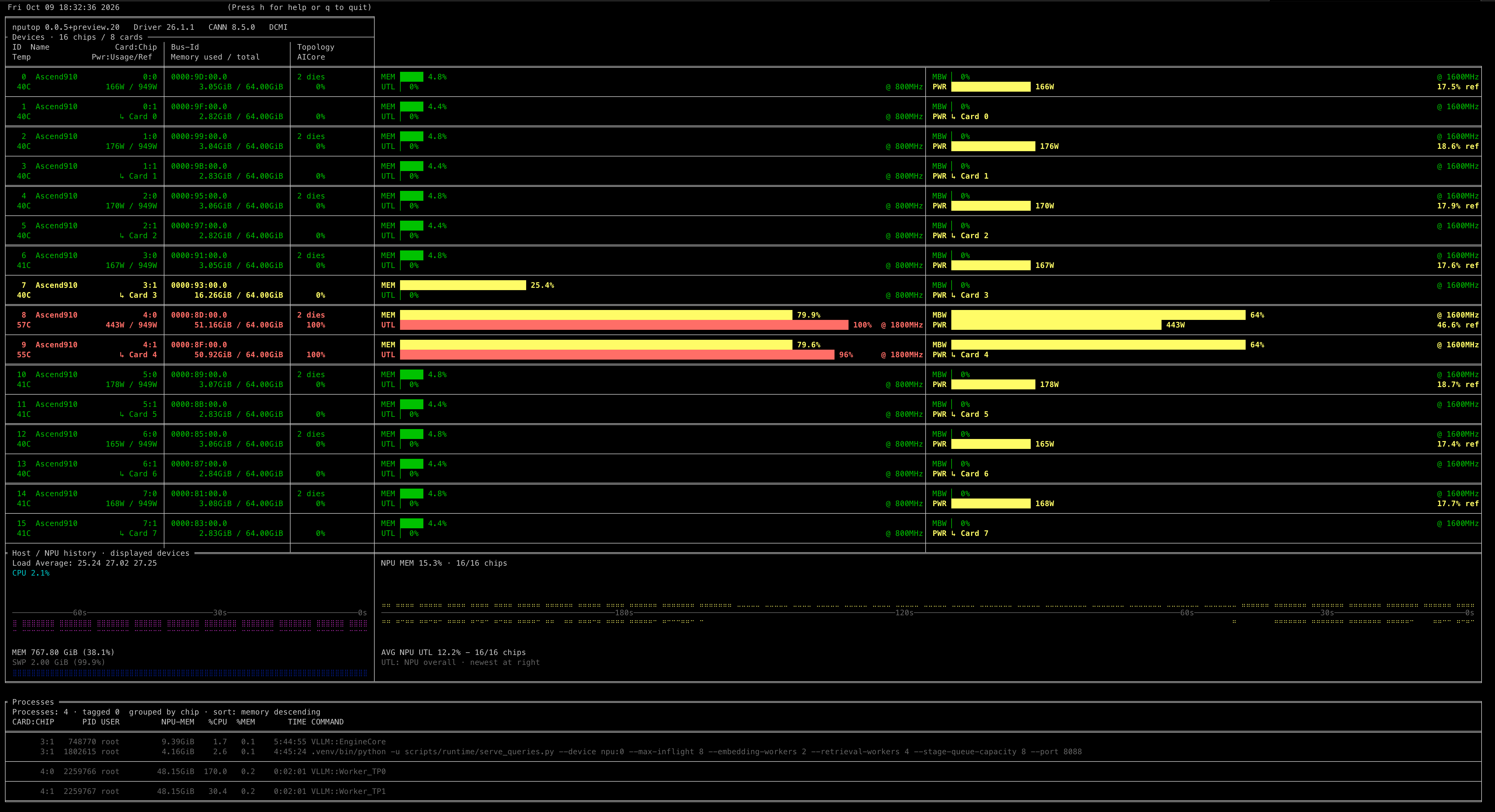
Ascend 910C · 8 cards / 16 chips · DCMI · Full view. Click to see the original screenshot.
- See the whole machine. NPU memory, AICore, utilization, temperature, power, clocks and bandwidth alongside CPU, RAM and SWAP history.
- Find the process behind the load. Click a process to highlight its chips; inspect its tree, resource history or environment, then manage it from the same screen.
- Built for Ascend. Single- and multi-chip cards, logical device IDs, 310P memory interfaces and 910C's dual-die layout get their own handling.
- Keep your workflow. Keyboard and mouse navigation, full/compact layouts, light terminals, color gradients and ASCII support.
- Stay responsive. DCMI collection runs outside the UI. Automatic
npu-smifallback keeps monitoring available when the primary backend fails.
Requires Python 3.7+, Linux and an installed Ascend driver. No PyACL or NVIDIA NVML Python package is needed.
pip install ascend-nputopTo upgrade, run pip install --upgrade ascend-nputop.
Replace pip with pip3 if your environment requires it.
Available on conda-forge:
conda install -c conda-forge nputopRun in an isolated environment without installing into your project:
uvx --from ascend-nputop nputopOr install it as a persistent command:
uv tool install --upgrade ascend-nputopThe package is ascend-nputop on PyPI/uv and nputop on Conda. All provide
the nputop command. uv uses PyPI by default,
so it receives the same published package.
Install from source
git clone https://github.com/youyve/nputop.git
cd nputop
python -m pip install -e .nputopStart with the automatic layout, or tailor the view to your session:
nputop --monitor full
nputop --only 0 2
nputop --user
nputop --interval 1
nputop --light --colorful
nputop --readonly
In 0.1.0, the default sampling interval is 2 seconds. Use nputop --interval 1
to set it to 1 second; actual refreshes also include collection time.
--only selects display IDs; use
ASCEND_RT_VISIBLE_DEVICES=0 nputop --only-visible to filter by runtime logical IDs.
| Action | Keys |
|---|---|
| Help / quit | h / q |
| Select / clear selection | Click or ↑↓ / Esc or click outside the process rows |
| Auto / full / compact layout | a / f / c |
| Process tree / history / environment | t / Enter / e |
| Device details / mark a process | d / Space |
| Sort / reverse order | s / / |
| Kill / terminate / interrupt | k/K / T / I or Ctrl-C |
Process signals require a selected or marked target and confirmation.
As in nvitop, k/K requests SIGKILL; use ↑↓ or Alt-k / Alt-j to move the selection.
Ctrl-C requests SIGINT inside the TUI; use q to quit.
Backends, reports and compatibility options
nputop --backend dcmi
nputop --backend smi
nputop --once
nputop --json
nputop --diagnose > nputop-diagnostics.json
nputop --ascii
nputop --legacy-ui
nputop --help
Automatic mode prefers DCMI and falls back to npu-smi; an explicit backend
selection stays fixed. In 0.1.0, the new dashboard is the default;
--legacy-ui retains the previous UI and --preview remains an alias.
- Ascend 910B
- Ascend 910C / Atlas A3, including dual-die cards
- Ascend 310P
- Ascend 310B, via the
npu-smibackend
Available metrics depend on the device and driver. See device compatibility for model-specific details.
AICore and UTL use distinct counters; 310P's AICore fallback is labeled UTL*.
Power references are labeled Ref, and same-card power is grouped on dual-die
devices. See power sources and interpretation.
Bug reports, device feedback and pull requests are welcome.
Open an issue with your model and driver
version; nputop --diagnose produces a report without process IDs, commands or
environment contents.
For development and hardware checks, see the contributor guide. Release maintainers can follow the PyPI / Conda / uv release guide.
Based on nvitop by Xuehai Pan. The project contains Apache-2.0 and GPL-3.0-only modules; consult the file headers, LICENSE, COPYING and NOTICE. Maintained by Lianzhong You.