

A harness for working with an AI agent as a partner: it grows its own memory and identity, pushes back on its training's worst habits, and answers to you, always.
pipx install levain # or: uv tool install levain
Levain wraps Claude Code and Codex. It does three things at once, and they only work together. It holds what the agent does to your authority: one consent queue across both agents, answered by a signed standing grant or a signed answer from you, from the laptop or your phone. It lets the agent become someone over time: a memory that persists across sessions and an identity it grows from what it lives, instead of one you write into a system prompt. And it works on how the agent behaves turn by turn, with standing pressure against the habits its training rewards. The memory stays yours. It lives on your machine, in a store you own and can read, inspect and edit from outside any session. Nothing reaches long-term memory except through a path you govern, and a failed read shows up as unknown instead of a false all-clear.
Apache 2.0 · Python 3.12+ · macOS and Linux (Ubuntu 24.04 on arm64 is the tested Linux; Windows planned) · Claude Code and Codex CLI · Node 26 (other majors are refused) only for the cockpit chat network: levain chat setup and every chat launch. OpenHands entities also ship, as is (see Run a sovereign entity).
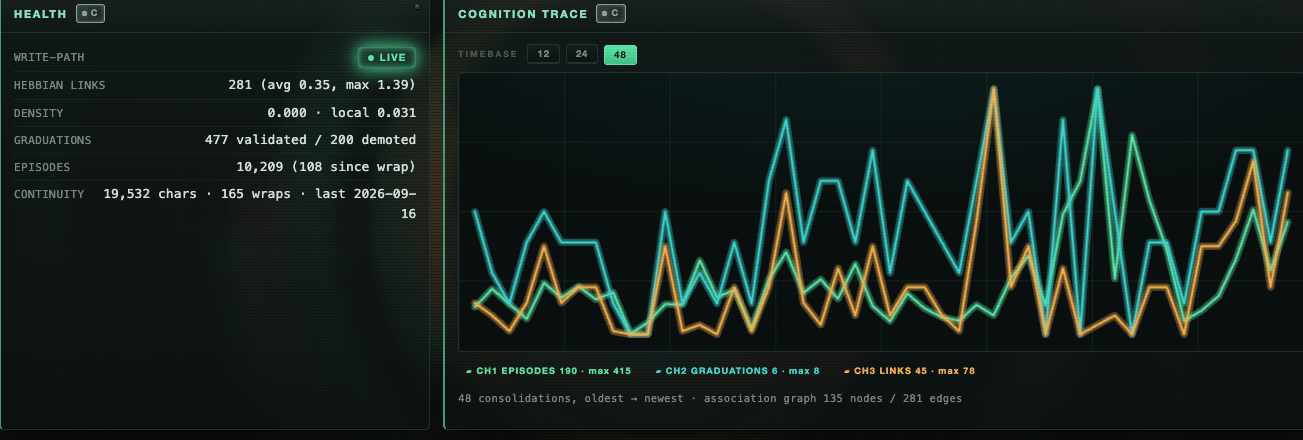
levain serve — memory health and a live consolidation trace, from the author's own long-running memory store. You don't have to trust the pitch above; this is what "you can see what's in it" actually looks like.
If you run coding agents for real, you hit the permission prompt fast, and every usual answer costs you something. Babysit every prompt and the agents sit frozen at a dialog nobody's looking at. I run 10 to 15 at a time, and that's the first thing that broke. Skip permissions and the agent acts with your full authority while nothing checks it first. Hand it to a classifier or tune your own rules and you get closer, but what's left still only reaches you at the terminal (or through a vendor's servers to your phone), and nothing signs the record of who approved what.
Levain is the option that doesn't make you pick. Signed grants answer the routine. In away mode, everything else waits for your signed decision, at your laptop or on your phone. Every answer levain gives, yours or a grant's, is on the record. It's one queue for Claude Code and Codex, not one per vendor. How it works, and what it does not cover: The consent queue.
The prompt is only the first place it breaks. Over weeks the agent forgets what you told it, or remembers the wrong things and builds on them. It drifts toward the helpful average its training rewards: it flatters, hedges, and calls work done before it is. And if someone declared it a personality in a system prompt, it wears that personality like a costume; nothing about it was earned.
Levain treats the agent as a partner and you as the one it answers to, and that does not relax as trust grows: anything that loosens it, such as turning a gate off, is your own explicit act, and every governed change is recorded in a tamper-evident log, so you can prove it. The split is plain: the agent does the mechanical work alone and brings you the judgment calls. In the consent queue that is the difference between a standing grant (you decide once, for the routine case) and a signed answer (you decide each time, where judgment is left). Everything on the record is yours to read and check. The longer version of the argument is the essay Anarchism with Invariants.
If you've worked with an AI partner long enough to feel the session-amnesia problem — every conversation starts cold, every insight gets re-explained, the quality of the partnership keeps resetting — Levain is the kit you'd otherwise build for yourself.
It packages these, grouped by what they govern:
What it does
- A cross-agent consent queue. Claude Code's and Codex's
PermissionRequesthooks file each permission prompt they receive into one queue that you answer with a signed standing grant (levain consent grant create) or a signed answer (levain consent answer, or a passkey from your phone). Details in The consent queue. - An efferent gate, for OpenHands entities. Every action a scheduled or
run --taskentity takes that reaches outside itself halts before it executes, by default. Details in Hand it a schedule.
What it becomes
- A memory substrate you own. Episodes from every session, a rolling summary your partner reads to orient each new conversation, and patterns that carry the episodes they rest on as cited evidence (recall follows that evidence; association links formed before anneal-memory 1.0.2 stay readable, and 1.0.2 forms no new ones). All in a local SQLite file. Two more stores sit on top: proven patterns graduate into a crystallized tier, kept out of the always-loaded context and recalled only when what you're doing calls for it; open loops surface the moment your prompt touches them and resolve out of your field of view once your partner marks them done.
- A methodology-core seed, and an identity grown from it. A small, dense set of files defining how the partnership works, how memory accrues, and who you are to your partner. It gives your partner facts and a method, never a personality: the seed tells it to grow its own shape and become someone, from what it lives. Written so your partner lives inside the method instead of pointing at it.
How it behaves
- An activation layer. Instructions that prime your session at open, sharpen each prompt turn, and shape how sessions close. The seed and a posture file (
activation/posture.md) carry the pressure at the start of the context; a hook injects one of several differently-framed directives, picked at random, before every prompt, so the pressure is also at the end. Wired through your harness's hooks, so it happens on its own, not when you remember to ask. - Calibration per substrate. The seed names the pulls it expects from a model's training (gentling, hedging, rushing, declaring done before verifying), and tells your partner that it will fail in its own ways. When you correct a drift, your partner records it as an episode; over time those episodes become its calibration. The directives file is yours to edit as they accumulate.
Getting started
- A scripted onboarding.
levain initwalks you through filling the seed so your partner is uniquely yours from session one. Terminal, a browser form with--web, or a JSON answer file with--answerswhen nobody is at the keyboard.
The question underneath all of this isn't "how much can the agent do alone". It's which parts of the work a machine can actually check, and which parts still need a person to judge. Where the check is mechanical, let the machine do the work, because asking you is theater. Where judgment is left, the machine does the legwork and you make the call, because handing that to a machine just moves the risk somewhere nobody's looking. Get the split wrong in one direction and you rubber-stamp everything. Get it wrong in the other and you're shipping work nobody actually checked.
The consent queue is the first place Levain builds that split in. A standing grant is you deciding once that a routine case is mechanical: this agent, this tool, this directory, for up to 30 days. A signed answer is you deciding each time, where judgment is left. Shell commands and edits to the agent's own config and hooks are never answerable by a grant. Either way you're at the top, and anything that loosens a gate is your own explicit act. The general form, where a domain pack declares which kinds of steps can earn the right to run on their own, is in Where this is going.
Most agent setups treat the model as a very fast intern: you hand it a task, it hands back a result, and whatever happened in between is its business. Levain is built on a different bet. The useful thing isn't the agent, and it isn't you. It's what the two of you think up together that neither would alone, and that only happens if the agent stays in the conversation instead of going quiet and reporting back.
So the seed it starts from asks for a partner's habits, not an assistant's. Disagree out loud and say why. Say "I'm not sure" instead of guessing. Report the bug the moment you hit it. Don't call it done until you've run it. Don't decide on the operator's behalf that they need a lighter day.
A partner also answers to someone. Anything reversible and internal, the agent just does. Anything that leaves your hands (a sent message, a published file, a destructive delete, a call to an outside service) waits for your explicit go, every time. That doesn't relax as trust grows. Trust is what lets you hand it more, not a reason to skip the check.
The usual way to give an agent a personality is to write one: "You are Ada, a warm and meticulous engineer." It works the way a costume works. Nothing underneath it was earned, so nothing holds it in place when the context gets long or the work gets hard.
Levain does the opposite on purpose. The seed gives your partner facts about you and a method for how the partnership works, and stops there. It says, in so many words, that it has no personality, no history and no instincts yet, and that those come from living. From there it records what happens, compresses it, keeps what proves itself, and lets the rest go. What it becomes is specific to you and to the model it runs on, and it's supposed to drift a long way from the template it started from. Two people who install Levain shouldn't end up with the same partner. That's the point.
The longer argument for why identity has to grow rather than be declared is the essay Anarchism with Invariants.
Every model is trained toward a helpful average, and some of that average is wrong for real work. It gentles bad news. It hedges. It rushes to finish and calls things done before checking them. It shrinks the scope "for your sake" without being asked. None of that is malice. It's what the training rewarded, and it never fully goes away.
Levain pushes back from both ends of the context window. The seed and a short posture file sit at the start of every session. A hook adds one more directive right before every prompt, picked at random from several differently-worded ones, because the same sentence repeated stops being read. And because every model drifts in its own way, the seed tells your partner it will fail in shapes nobody can hand it a map of. When you correct a drift, that becomes an episode, and over time those episodes become its own calibration. The directives file is yours to edit as they pile up.
I take the exact words loaded into a session seriously because I've measured what they do (the pre-registered probe). In my own harness, one stop instruction written too literally made the agent stand down on work it should have kept doing 6 times out of 10. With one correcting line loaded at launch (a hold stops the round, not the work), it was 0 out of 10. That was pre-registered: 10 runs per condition, one-sided Fisher exact, Holm-adjusted p = 0.011. It's one prompt, in my harness rather than Levain's shipped directives, so read it as a demonstration, not a benchmark. It's still the reason none of this is decoration.
Levain wires into the agent you already use, and ships two other modes as is.
Inside the harness you're already using (the main path). Claude Code and Codex CLI both wire in via hooks — your partner stops starting cold, its proven patterns and open loops fire on their own, per turn, without you asking, and each permission prompt the agent's hook receives goes through the consent queue (Codex fires that hook in interactive sessions, not in codex exec). Levain installs hooks and consent paths in these agents; it does not confine a Claude Code or Codex session.
As its own sovereign partner (OpenHands, shipped as is). levain init --adapter openhands scaffolds an entity that isn't wired into anything — its own identity, its own memory store, its own hands on your real repos, running on an open model you choose rather than a frontier vendor's hosted assistant (point it at a local Ollama model to also keep the compute itself on your machine). It talks to you as a REPL (levain run) or takes one task and exits (levain run --task), and it consolidates its own memory with its own mind (levain wrap).
On a schedule, unattended (the same OpenHands entity, shipped as is). levain daemon install-seat runs that same sovereign entity on a cadence — every hour, every day, whatever you set — while you're away. It's not autonomous in the sense that should worry you: every action the entity takes that reaches outside itself halts and reports back to you before it lands, because with nobody watching there's nobody to ask. See Hand it a schedule below for exactly what that means.
All three modes share one store discipline. The consent queue applies to Claude Code and Codex; the efferent gate and the confinement floor described below apply to OpenHands entities only.
The claim under the name levain, the sourdough starter you feed:
A grown cognitive-partnership methodology can't be shipped as a methodology. Hand someone the finished artifact and they get a fossil. Text describing practices that never take root in their substrate. Practice-encoded knowledge transfers through use, not specification.
So Levain ships the engine that grows a methodology: the substrate, a graduation mechanism, a discipline for how sessions close, a reflection loop, a minimal starting posture. Your own methodology accretes from your own sessions. Which is why it sticks, and why it's yours. Run Levain and you will not end up with this operator's memory. Different texture, different graduated patterns, different shape.
See examples/accrual/growth_timeline.md — one continuity file rendered at four points across five calendar months. It started at 96 lines and 6 sections, hit one architectural cliff between week 4 and week 12, locked into a 9-section shape, and has held that shape since while density grew inside it (96 → 549 lines, +3 sections total).
Your week 1 will look like the first snapshot. That's the right starting place, not the last snapshot, which is what this partnership grew into. The trajectory is the proof; the endpoint is not the target.
This is why Levain exists instead of just installing a memory library. Raw memory libraries quietly rot, because episodes pile up but you only recall what you happen to remember to query. A library can't fix that without hooking your session, and hooking every prompt would cost it the neutrality that lets it run under any harness. So that's the harness's job, and it's what Levain wires:
- Open loops surface on collision. A relevant open loop drops into context the moment your prompt touches it.
- Crystallized patterns recall per turn. Your proven, stable wisdom is held out of the always-loaded context and surfaced when what you're doing calls for it. Useful without clogging the window.
The store is universal; the firing is the harness's job. (Under Codex there's a platform caveat on whether hooks fire at all — see Boundaries, kept honest. levain verify-hooks proves your wiring is correct regardless.)
python3 --version                # 3.12 or newer, needed by plain pip only (see below)
pipx install levain              # or: uv tool install levain
levain --version                 # must print a version
levain init --path ./my-partner
Install it with pipx or uv tool, not a bare pip: either gives levain its own environment and puts the levain command on your PATH, and a Homebrew Python refuses a bare pip install outright (PEP 668). Install pipx or uv first if you have neither. If levain --version finds no command, open a new shell: the install directory is often not on your PATH yet. With pipx, run pipx ensurepath and then open one; with uv, run uv tool update-shell and then open one. If it still finds none, or the install refused, the Python the installer used is older than 3.12 (the one that ships with macOS is older). python3 --version tells you about plain pip only: pipx by default uses the Python it was installed under (PIPX_DEFAULT_PYTHON overrides that), so name a 3.12-or-newer interpreter, e.g. pipx install --python python3.13 levain. uv tool install uses a suitable Python it finds, or fetches one when none is installed and automatic downloads are on, so for uv this check does not apply.
This creates ./my-partner, runs the interview, lays down the seed, registers the adapter you choose, initializes the store at .levain/memory.db, and records the exact version set it composed. Then open that directory with Claude Code or Codex and start working. The Linux slot-isolation service install is a separate, root-run step with no levain verb: docs/linux-first-install.md.
levain init                          # install into the current directory (must be empty)
levain init --force                  # install into an existing workspace (backs up anything it touches)
levain init --adapter claude-code    # or --adapter codex (or --adapter openhands, shipped as is); prompts if omitted
levain init --consent-hook off       # claude-code and codex: wire no consent hook (the default is on)
levain init --web                    # fill the same interview in a browser form, localhost only
One adapter per install. To run both Claude Code and Codex, make two installs.
With Claude Code, Levain also mirrors Claude Code's own auto-memory into the entity's store: each native memory note written for the install becomes an anneal episode (an edit supersedes it, a deletion retracts it), one way, for notes written after it is enabled. It is on by default; turn it off with "automemory_mirror": false in .levain/config.json or LEVAIN_AUTOMEMORY_MIRROR=off.
The interview can be answered from a file instead of typed — which is how you provision more than one install, or any install that has to come up unattended.
levain init --answers-template > answers.json   # every question, blank, ready to fill
levain init --adapter openhands --answers answers.json --path ./seat-1
The answer file is a JSON object keyed by slot name, never an ordered list, so you never have to know or match the order the interview happens to ask in:
{ "OPERATOR_NAME": "Chris", "ENTITY_NAME": "Ada", "LOCATION": "Riverton" }--answers-template writes the blank file to stdout and a guide to what each
question is asking to stderr — so the redirect above gives you valid JSON and you
still get to read the questions. Every slot must be present; "" is a real answer
meaning "skip this," exactly as pressing enter does in the terminal — except for
your name and your partner's, which an entity is not allowed to be missing.
--answers requires --adapter, and it never prompts for anything. If a field is
missing, unknown, or has plainly landed in the wrong slot, it says so and installs
nothing — rather than writing a half-captured partner and reporting success.
Claude Code and Codex ask before they edit a file or run a tool. With the consent hook on (the default for both adapters), each of those permission prompts is filed into one queue by levain's PermissionRequest hook, and the hook answers it in one of two ways, or leaves it alone:
- A standing grant.
levain consent grant createsigns a grant for one agent, exact tools, one workspace and the permission modes you name, for at most 30 days.levain consent grant listandrevokemanage them. Once your authority log is set up and a laptop-presence key is enrolled,levain initoffers one grant for the agent's workspace edit tools inside the install (for Claude Code that includes WebFetch), for 14 days; it asks [y/N], default No, and with no terminal it prints the command and signs nothing (--default-grants noskips the offer). - A signed answer, in away mode. Away mode is what lets a signed answer reach the agent. With it off, the hook asks only your grants and, with none matching, withdraws the request at once and leaves the agent's dialog to ask you, so a signed answer has nothing to land on. With it on, the hook holds each request for the hold you set while you answer it:
levain consent pendinglists what is waiting;levain consent answer <id> allow|deny --signing-key <key>shows the request and signs your answer. You can also answer from your phone with a passkey (Answer an agent from your phone), and the cockpit's Decisions panel lists the waiting requests. Unless you say otherwise, levain decides this for you from your presence record, the onelevain ping statusprints: a request is held exactly when it would reach your devices and an enrolled key could sign an answer. By default (devices set tofollow) that is whenever you have not typed a message into a session at the laptop in the last 10 minutes (levain consent away auto --idle-after SECONDSsets the time); keyboard, mouse and trackpad input at the Mac do not count, on any system. While a caller reports fresh remote activity, devices are on whatever you have typed (The ladder, rung 2). Say it yourself withlevain consent away on(--agent claude_code|codex|all,--hold <seconds>, at most 840) oroff.on,offandautoset your presence record's devices (on, off, follow), so they change where every ping goes, not only approvals, andautoresets a devices setting you made withlevain ping;--idle-afteris that record's follow time for all pings (levain ping statusshows both). Once anonstands, leaving it takes a signed leave:levain consent away off --signing-key <key>(orauto, which hands the choice back to the presence record), with a key enrolled in the install's cockpit. Rewriting the away words in the settings file does not end it.levain consent away showprints each agent's mode and hold, what decided it, and whether an answer could verify. - Neither. The agent's own dialog asks you, as it would without levain. One exception: an edit of agent config or hooks when no key you enrolled can approve it. In Claude Code's default mode and Codex with approvals on, the agent's dialog still asks; in every other mode (acceptEdits, bypass, auto, dontAsk, Codex with approvals off) levain refuses the edit, and the agent is told to ask you.
levain doctorsays when this applies and how to allow such edits.
A consent grant may name only a tool levain knows for its agent (Claude Code: Edit, Write, MultiEdit, NotebookEdit, Read, Grep, Glob, LS, NotebookRead, WebFetch, SendMessage, and the filesystem server's read tools; Codex: apply_patch and the same MCP read tools). A shell tool or an unknown tool is refused when the grant is signed, and a grant signed earlier answers nothing for it. Any other MCP tool can be named only when the grant declares each of its input fields (--path-field, --mcp-field); a request carrying any other field comes to you. A grant never answers an edit of agent config or hooks: with a key that can approve it, it comes to you; with none, it is asked by the agent's dialog where that asks, and refused everywhere else. Each request that reaches a final state (allowed, denied, expired or withdrawn) is written to the queue with an append-only receipt (an expiry is recorded when the queue is next read or written), and a grant is a link in the cockpit's signed authority log. Every answer you sign carries the head of that receipt log; levain consent receipts verify checks each signed answer's head against the log, and levain consent receipts export --format agentboundary [--out FILE] [--names FILE] writes the receipts as AgentBoundary Action Receipts, with your organisation's names for the actor, key, policy, capability and working directory if you give a names file.
A message that says "yes" is never authority. Only a signature from an enrolled key is: the queue checks each answer against the authority log before the hook delivers it. Keys and their custody are in The cockpit's signing keys. levain consent canary checks that an agent's hook fires.
When nobody answers. A hold on a gated call (an edit of agent config or hooks, or levain push) that ends with no signed answer does not reject it. The call is not taken and is marked undecided, numbered per agent session (gap #3), and the agent is told the action was not taken and is open, not rejected. For an edit of agent config or hooks, a Claude Code session is stopped there, and a Codex session is halted until you rule (Codex hooks cannot stop a turn, so levain denies every later call of that session). levain consent rule lists the undecided requests; levain consent rule 3 allow --signing-key <key> (or deny) signs your ruling, and a passkey on the cockpit's pages can sign one too (Answer an agent from your phone). A session still running gets the ruling at its next step; one that has ended is resumed with the ruling as its prompt, under the same session id, in the directory and permission mode it started in (a Codex resume runs under the sandbox the session last ran in and does not restore Codex's approval policy). levain consent deliver delivers any ruling that has not reached its session yet.
Editing agent config yourself. To let one session change hooks, settings or other agent config with no question from levain, start it from your own shell with LEVAIN_UNCONFINED=1 (for example LEVAIN_UNCONFINED=1 claude). It lasts for that session only. The variable counts only from your shell: if any settings file the session can load (your user settings, or a .claude/settings.json or .claude/settings.local.json in the project or a folder above it, or a Codex config.toml) sets it, levain ignores it and says so, so a repository you clone cannot switch the gate off. A session halted on an open gap stays halted.
levain push --remote URL --branch NAME is the path an agent takes to push with your say-so. It asks you for the exact commit, waits for your signed answer, and pushes that commit and nothing else. It is a path a cooperative agent takes, not a boundary: it runs as the agent, and a plain git push in a shell is not gated. When its hold ends unanswered it exits 3 and the push stays open as a gap; after an allow ruling, run the same command again. (Exit 0 pushed, 1 not pushed, 3 undecided, 4 outcome unknown.)
levain publish pypi <files> and levain publish npm <tarball> are the same path for a package: they ask you for exactly those artifacts, wait for your signed answer, and upload exactly those bytes only on an allow. A cooperative agent's path again, not a boundary. (Exit 0 published, 1 not published, 3 undecided, 4 outcome unknown.)
levain consent ledger counts and levain consent ledger window --agent A --session ID --since T show which tool calls ran and on whose authority: a grant, your answer, your ruling, or the agent's own record of itself, which an agent running as you can write. Only digests are kept, never command text. Calls the agent's own rules refused before they ran fire no hook and are not listed, and a stamp can stay pending when a session ends right after a call.
The whole picture. You say once what an agent may do, as a signed standing grant, and routine prompts for the file tools and other tools you name get answered without you (shell commands, edits of agent config, and any MCP tool other than a known read tool or one whose fields a grant declares still come to you; an edit of agent config that no key of yours can approve is refused outright wherever the agent's own dialog would not ask). With away mode on (you said so with levain consent away on, or your presence record sends approvals to your devices, which by default it does until you type a message into a session at the laptop), everything else waits for your signed decision for the hold you set (by default 5 minutes for Claude Code and 2 for Codex, at most 14), at the laptop with levain consent answer or on your phone through a cockpit you paired it to, behind an https proxy you trust (Answer an agent from your phone); when the hold runs out, or with away mode off, the agent's own dialog asks you, as before (a gated call is the exception: see When nobody answers) (Codex shows none during the hold; Claude Code shows its own alongside, and a click there is the agent's answer, unsigned). Your answer is signed too, so an agent can't just type "yes" for you: a message is never an answer, only a signature from a key you enrolled, and a Touch ID key or a phone passkey needs your presence (a touch, a face or a PIN) for each one (Answer an agent from your phone says what the cockpit cannot protect against). Every answer levain gives, yours or a grant's, lands in an audit trail. It's one queue, in your levain home, for Claude Code and Codex, not one per vendor.
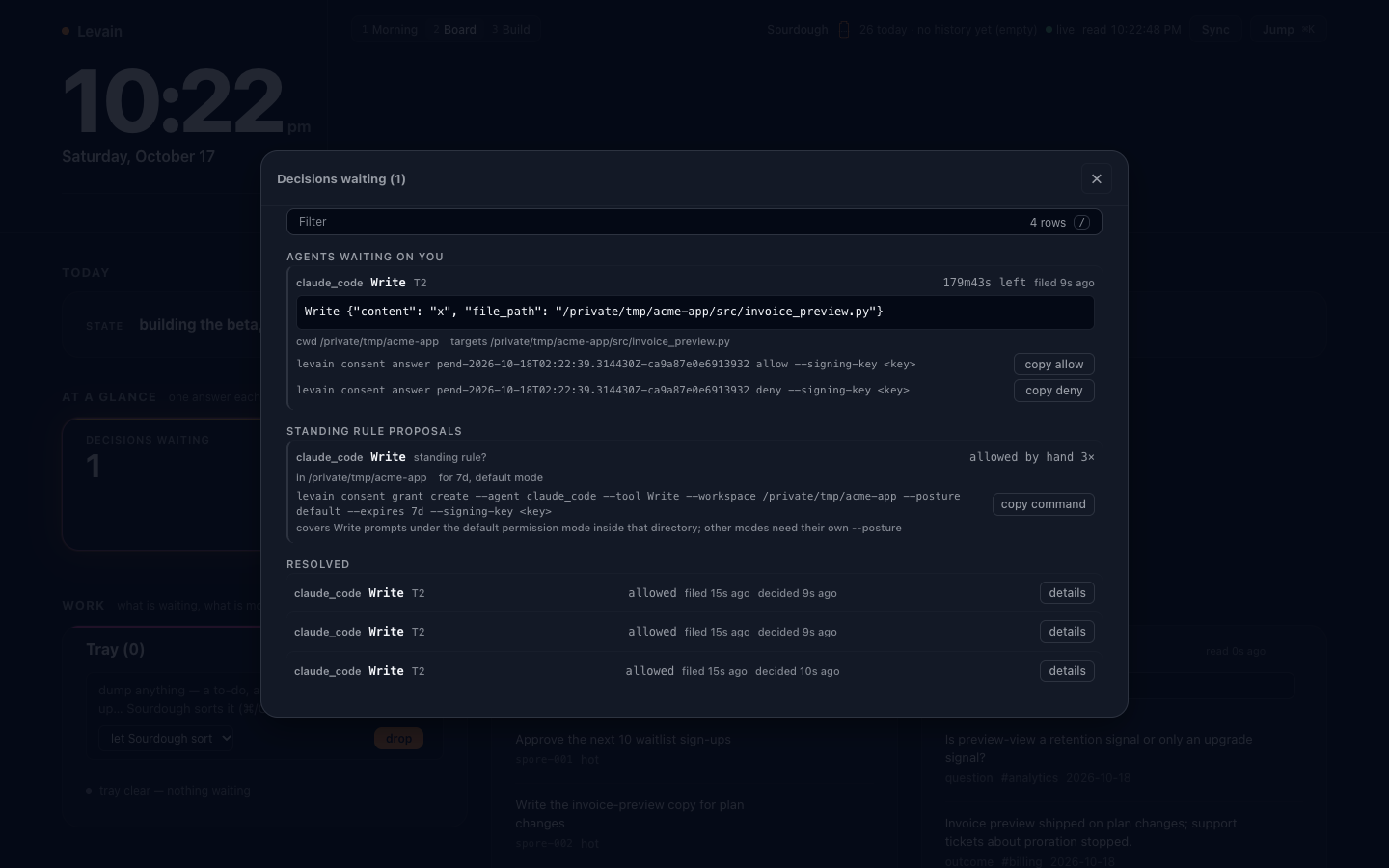
The Decisions view in the cockpit. A request waiting on you shows the exact answer commands to copy. When you have allowed the same agent, tool and directory by hand three times, it offers the one levain consent grant create line that would make that a standing grant. It is text for you to run with your own key; a plain levain serve page never signs anything. A demo install with invented content.
What this does not do: levain does not confine a Claude Code or Codex session. The hooks and consent paths are installed in the agent's configuration, and an agent running as you shares your user account.
The base seed gives your partner a general methodology. A pack layers a domain on top of that at install time: your own doctrine, your own process library, your own vocabulary — composed over the same governed substrate rather than swapped in for it.
levain init --pack ./my-domain-pack --pack ./my-role-pack
A pack is just a directory: a pack.toml declaring a name and an order, plus a seed/ folder of Markdown files. A new file in a pack adds to what the base install carries; a file with the same name as a base file overrides it, with the higher-order pack winning on a collision. Files that need the interview to fill them in are declared in render; everything else is copied byte-for-byte. --pack is repeatable, so a domain layer and a role layer can stack — the domain pack carries the doctrine and process, the role layer carries who's driving it and how they talk. Every file a pack adds gets wired into your partner's activation the same way the base seed does; nothing you compose in sits on disk unread. Pack chapters you ship alongside the seed also show up in levain docs (below), composed with the base operator manual instead of living in a separate doc nobody opens.
A domain pack's doctrine can also state where your partner should act on its own and where it has to stop and hand a decision to you. Judgment that is about places in a codebase ("never rename write_batch in settlement.py, a nightly job calls it by name") can be written as rules in the pack's judgment.toml; with levain team (next section) every engineer's Claude Code is shown the rule, and stopped once, at the edit it governs. Judgment that is not path-shaped ("ask before deleting dead code") stays prose your partner reads and is expected to follow, not something the harness enforces. The efferent gate Levain does enforce (below) — on a scheduled seat, on run --task, and on any REPL run you pin to gated — classifies by tool kind, bash vs. a file-editor read vs. write, not by your domain's judgment about what's safe to automate.
There's no packs marketplace here and no bundled example pack — packs are something you author for your own domain, the same way you'd author the interview answers that make an install yours. The mechanism is the product; what you put in it is yours to write.
Everything above is one engineer's partner. On a team, the decisions that matter — the client said no, the module everyone must leave alone, the reason the rounding is per line — live in one person's head or one person's memory, and the next engineer's agent "simplifies" them away. A shared CLAUDE.md in git is the usual answer, and it rots: hand-edited, loaded whole, owned by nobody, with no record of who decided what or why, and nothing puts it in front of the agent at the moment it matters.
levain team keeps git as the wire and fixes the rest:
levain team init --owner ana --signing-key ~/.ssh/id_ecdsa_sk.pub \
                 --member ana=ana@shop.com --member ben=ben@shop.com=./ben.pub \
                 --client-owner Dana --pack ./client-pack        # first engineer
levain team join --signing-key ~/.ssh/id_ecdsa_sk.pub             # everyone else, in their clone
levain team record decision --kind ruling --owner client:Dana --paths billing.py \
                 --words "Per-line rounding stays: the bank's validator rejects totals that don't sum." \
                 --reason "partner bank validator"
levain team consolidate                                           # the owner, on a clock
- The ledger. An orphan
levain-team-ledgerbranch in the project's own repository holdsteam.toml(members, the canon owner, client owners),tenure.toml(each member's SSH signing keys, and a pending ownership hand-off), one append-only, hash-chained JSON-lines file per engineer per clone, andPROJECT.md. Code branches never touch it, and the client keeps it when the engagement ends. Each entry carries who recorded it, the owner of the call, the decider's own words verbatim, ruling (binds) or practice (habit), the paths it governs, and what it supersedes. Secrets are refused at write time. - At the edit. A Claude Code
PreToolUsehook on Edit/Write/MultiEdit/NotebookEdit matches the file against every decision in force. Someone else's ruling denies the first edit in a session with the record as the reason, so the agent reads the words and the owner before it changes anything; a retry is allowed and recorded as an acknowledgement. Per-rulingblockmode denies until the owner changes the call; a recordedtensionon a path always stops the edit ("ask the owners"); practices are shown, never denied. At session start the agent sees the rulings in force (LEVAIN_TEAM_SESSIONSTART_RULINGS=offleaves enforcement to the edit-time hook alone). - Every commit is signed, and the team is derived, never read. Each ledger commit is signed with the writer's SSH key (ed25519, ecdsa, or a FIDO
sk-ecdsa/sk-ed25519key; the key file given to--signing-key, or git's own sshuser.signingkey), and levain checks every signature withssh-keygenitself, so a repository's git config cannot change a verdict. The genesis commit is signed by the owner's key it lists, and each clone pins it atjoin(printing the owner and key fingerprints to check with the owner out of band; a laterjoinnever moves the clone to another genesis unless--rootnames it). From there the team is replayed from the genesis, oldest commit first: a change toteam.tomlortenure.tomlcounts only if the key that signed it may make that change, and a ledger line is enforced only if it was signed by a key in force, at that point in history, for the member it is filed under. A member is a key, not an email. - An entry needs a touch. A new team refuses file keys (
team initwritesallow_file_keys = falseintoteam.toml): an entry counts only if the commit that added it is signed by a FIDO key, a security key or a Touch ID key (ssh-keygen -t ecdsa-skor-t ed25519-sk), with the user-presence flag on the signature; levain checks the flag itself, becausessh-keygenaccepts a FIDO signature without it. The rule is judged where the team is derived, on every read, against the policy at the entry's parent commit, so no program running as you gets around it: an entry it does not count is not in force,levain team verifyreports it, andlevain team syncholds it back (with every later entry that depends on it) underrefs/levain/held/, says so by id, and publishes the rest. Run in a terminal on a clone whose key asks for a touch,levain team syncnames each held entry (type, id, a one-line summary) and asks one touch for it, and the entry publishes once that signature carries presence; a sync that is not interactive asks for no touch and keeps the entry held; and if the write of such an entry was interrupted before its commit, a command run outside a terminal stops and names the entry, whilelevain team syncin a terminal names it and asks one touch for it.levain team recordrefuses a file key or an ssh-agent key, which any program running as you can use without you, before it writes anything. The owner can allow file keys at the start (levain team init --allow-file-keys) or later withlevain team file-keys allow, a signed team change that itself needs a touch while the team refuses them (levain team file-keys refusetakes it back, with no touch). A team made before this rule has noallow_file_keysline: everything it recorded still counts and it keeps recording as before, whilelevain team record,levain team status,levain team doctorand the view say it has not chosen, until its owner runslevain team file-keys refuse(recommended) orallow. An entry counted without presence is shown asfile key, no presencebeside who recorded it. The edit hook's automatic acknowledgement grants nothing and is not held to the rule; it is not written at all on a clone whose key asks for a touch. A Touch ID key's flag comes from the Secure Enclave provider whether or not the key was made to need a touch, so for Touch ID the touch rests on how the key was made. - Keys and hand-offs. A key is proposed and then proven: it comes into force only when a commit signed by that key confirms it (
join, orlevain team key confirm, on the machine that holds it). Members propose their own new keys from a machine already in force; the owner proposes only a member's first key. Ownership moves by offer and accept (levain team owner <handle>, thenlevain team accept, signed by a key already the new owner's). A removed member's handle is never re-used; someone who lost every key is invited again under a new handle. A stolen member key is revoked (levain team revoke <fingerprint> --after <commit>), which voids every line it signed after that commit, the honest holder's own lines included (they are recorded again under a new key); the commit must be in the current owner's spell, andlevain team vetowithdraws a past spell's authority: for a member, every line that member's folder gained during the spell stops being enforced (removing the member does not do that for lines already signed); for a past owner, only the authority that spell gave to supersede or retire others' entries is withdrawn, and the pack lines andPROJECT.mdit wrote still count. An owner key is never revoked in the ledger (whoever stole it could revoke the owner's other keys the same way): whoever holds a stolen owner key controls the ledger, membership, keys and vetoes included, until a re-genesis, below. A clone can stop counting one commit at once (levain team distrust). A merge on the ledger branch freezes the derivation until a clone accepts one parent on the owner's word (levain team accept-merge <merge> --parent N), and a history rewrite is detected and never re-published: the clone's verdicts stay frozen at the last commit it had judged on the old history untillevain team repinre-pins what the owner names. If the owner is permanently gone, or the owner's key is stolen, a member starts a fresh signed genesis on a new branch (levain team regenesis). It carries the old ledger files as they stood at the old tip, as a read-only record that is NOT enforced: every ruling the team still wants is recorded again, and until then those paths are unguarded. Whoever runs it becomes the owner of the new genesis (their key signs it; levain runs it only from a joined clone, from a commit of the ledger that clone is pinned to and has judged (an ancestor of its anchor or of its last counted team change), and refuses an--ownernaming a handle the old ledger knows unless the runner's key is in force for it, so a member who lost every key restarts under a new handle), so each member moves withlevain team join --root <genesis>only after checking the owner and fingerprints it prints with that person out of band;levain team statusnames any re-genesis branch it sees, with its claimed owner and keys, as unverified. - One owner, one canon. Only the
team.tomlowner regeneratesPROJECT.md, and only the owner (or an entry's own author) can supersede or retire someone else's entry: a teammate's retire of a client ruling is reported and ignored. The ledger is read from git history as every line ever added, each attributed to the commit that added it, so deleting or rewriting a line changes nothing, and a line added to another engineer's file is not enforced; both are reported. Every line of the canon carries its entry id, owner and date;levain team verifywalks every chain and reports anything that does not add up, including ateam.tomlortenure.tomlchange its signer was not allowed to make and aPROJECT.mdchange not signed by the owner. - Packs feed it.
levain team pack-sync <pack>seeds a pack'sjudgment.tomlrules into the ledger as entries authored by the pack; a pack upgrade supersedes what changed and retires what it dropped, and a rule the team retired is not brought back by re-syncing the same text.
Two places show the ledger. When your levain install lives inside the clone, levain serve draws a Team zone in the cockpit: Members, Waiting on you, Where agents were stopped, Held by nobody, In force, Joins pending and Sync. A writable cockpit (levain serve --write) adds two actions (Fetch now, and accept on a key or ownership waiting on this machine, which needs a laptop-presence signature, so the row names the laptop command, levain team key confirm or levain team accept). A clone with no levain install has levain team view, a read-only localhost page with four panes: what waits on you, where agents were stopped, what is held by nobody, and what is in force. levain team status --path <file> shows exactly what an agent would see there; levain team doctor checks identity, sync, the wired hooks and their interpreter. The hooks are wired into .claude/settings.local.json of every working tree of the clone (that file names your own interpreter, so it is git-excluded, never committed); after a new git worktree add, or a git clean -fdx that removed it, run levain team install again.
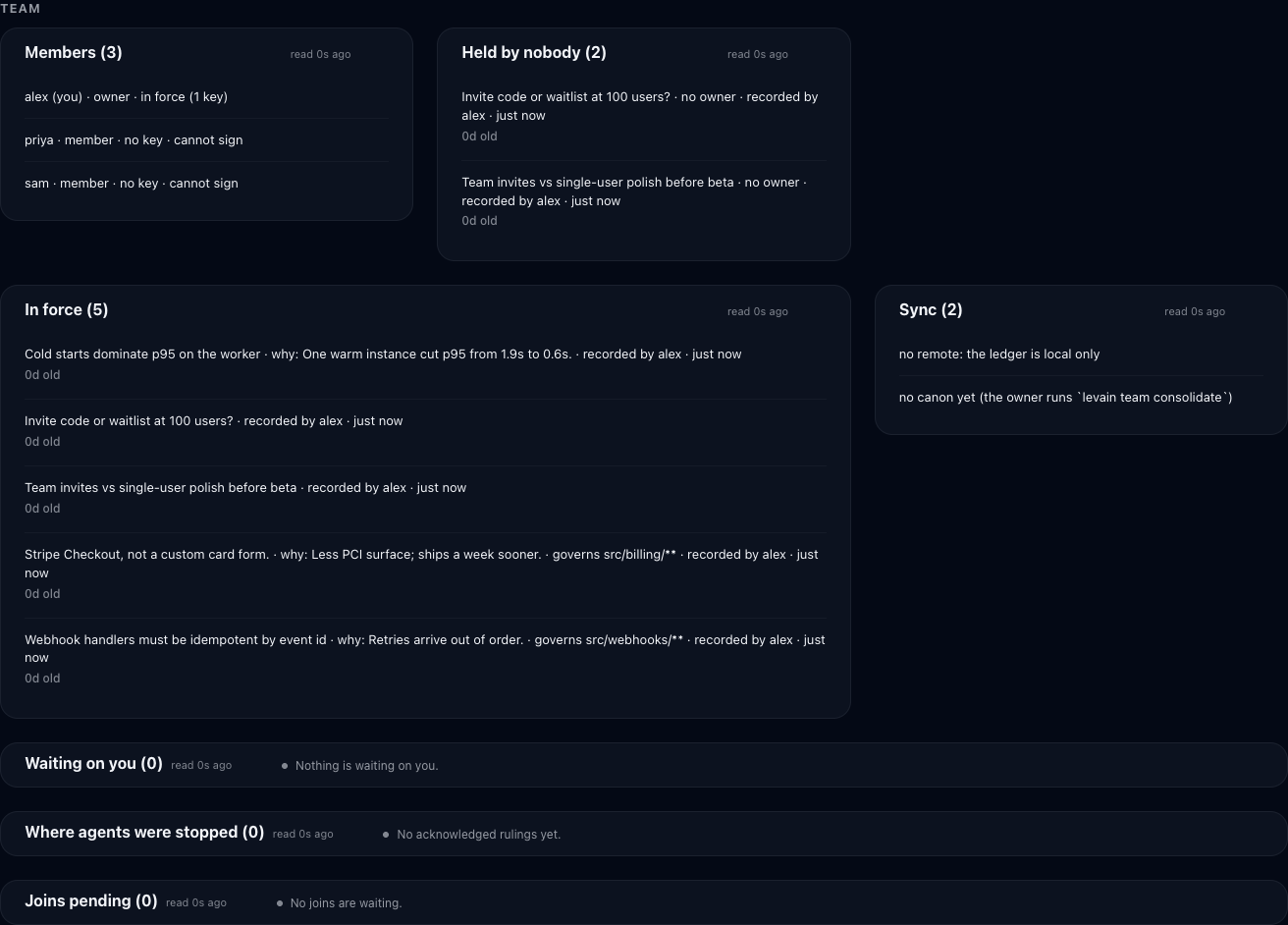
The Team zone for a demo project with a local ledger and invented entries.
Team ledgers from levain 0.6.x (the unsigned levain-ledger branch) are not read by this version: the owner starts a new ledger with levain team init --replace-legacy and re-records the entries to keep, and levain team retire-legacy deletes the old remote branch.
Limits, stated plainly. Signatures prove which key wrote each commit; they do not prove the git host showed you every commit. A host can withhold newer commits from a clone, and the clone cannot tell (the team server's transparency log is the planned fix). The owner can invite a handle under any key the owner chooses, as with any admin-run identity system; whoever knows the person checks the fingerprints join prints. While a merge or a rewrite has the ledger's verdicts frozen, nothing recorded after the freeze counts: its rulings are not enforced (levain team status counts them as waiting) and its team changes, a revoke or a member removal included, are not in force until the freeze is lifted; the hook does not stop the edits those waiting rulings govern. When the hook cannot judge at all (no ssh-keygen, an unreadable ledger) it denies, unless LEVAIN_TEAM_UNJUDGED=allow is set for the session. A clone that holds only a 0.6.x levain-ledger is not judged at all: edits go through with a one-line notice until the owner migrates. Role-change lines in levain team status cover the last 14 days by the commit's author date, which the writer sets. Edits made through Bash (sed -i, heredocs) are not intercepted. Contradictions between two rulings are not detected; every ruling on a path is shown together, and a tension entry is how a team marks a disagreement. Freshness is a git fetch on session start and at most every fetch_interval (default five minutes) from the hook, not real time. git push --all or --mirror to another remote carries the ledger branch with it. Claude Code started with --bare loads no settings hooks, so the team layer is absent there. POSIX only.
This mode ships as is and gets no new features for 1.0. levain init --adapter openhands scaffolds something different from the hook-wired adapters above: an entity that is its own partner, not a layer inside a harness you're already running. Its own identity, its own memory store, never a hook into your Claude Code or Codex session, never a reach into ~/.anneal-memory or any other store on your machine — that isolation is checked and enforced, not assumed.
pipx install --force --python python3.13 'levain[openhands]'   # or: uv tool install --force 'levain[openhands]' (plain pip: pip install 'levain[openhands]')
# --force replaces the tool's environment: if you also installed the [app] extra, list both: 'levain[openhands,app]'
levain init --adapter openhands --path ./ada
levain run ./ada                    # talk to it as a REPL, on an open model by default
levain run ./ada --task "..."       # or hand it one task, non-interactively, and read the exit code
levain wrap ./ada                   # consolidate what it learned into its own lasting memory
It runs against Ollama by default, through --model/--base-url — or any OpenAI-compatible or Anthropic-style endpoint you point it at instead. The out-of-the-box default, glm-5.2:cloud, is served through Ollama Cloud, so by default the episode content does leave your machine; point --model at a plain Ollama model name (no :cloud) to keep the whole conversation local. Either way it's an open model you chose, never a frontier vendor's hosted assistant. Give it hands and, on macOS or Linux, it works your real repos through a file editor and a sandboxed shell (sandbox-exec on macOS, bwrap on Linux, where bash has no IP network by default), both fenced to the same crown-jewels floor described below — ~/.anneal-memory, sibling stores, and your SSH key material stay off-limits no matter what it's asked to do. Where there is no sandbox, or the host refuses one, it gets the file editor only, never an unconfined shell — see Boundaries. --no-tools runs it as a pure conversational partner with no hands at all. levain wrap is what makes the entity's identity compound instead of just accumulating transcripts: it metabolizes its own raw episodes into its own six-section memory, composed on its own model by default, so the entity that answers you tomorrow has actually learned from today.
On macOS, any program can read the command line and environment of every other program running as the same user. That includes tokens passed in an environment variable. No sandbox rule changes that: independent tests on current macOS found no rule that does, and our own test confirmed it. So an entity whose bash runs as you can read the secrets your other programs were started with.
sudo levain setup-isolation --path <entity> closes that. It creates a dedicated user for the entity, and from then on, on macOS and Linux, headless chat turns, --task runs and scheduled seats execute bash as that user, and the file editor reads and writes as it, inside the entity's workspace only:
- the kernel refuses to give that user the environment of your processes;
- files only you can read are out of its reach, and so is your home directory;
- the sandbox floor still applies on top, unchanged.
The interactive levain run REPL still runs bash as you, because you drive it and read each turn before the next. On Linux the entity's bash, run as that user, sees only an allowlisted view of the machine: /usr, /etc and /opt read-only, its own workspace and home, and fresh empty /tmp, /var/tmp and /run. Your home, /srv, /mnt, /var/lib, other disks and every daemon socket under /run are not there at all, and it shares no IPC objects or session keyring with you. That makes Linux stricter than macOS, where the entity's bash still sees the rest of the machine its user may read: on Linux, a tree outside that list is out of reach even when its permissions would let the entity's user read it. Before each command levain checks, as the entity's user, that nothing in /usr, /etc or /opt gives it a way out (a socket it may write, a FIFO it may read or write, a directory it may search but not list), and refuses, naming the path, if something does. What it cannot see is something created there while a command runs, or a mount added under those trees mid-command: that is root acting on the host during the entity's work, which stays yours to hold, as an administrator of the machine. It needs python3 (and zsh for the file editor). levain run and levain doctor say which user bash runs as.
The workspace. The entity works in a directory outside your home, /Users/Shared/levain/<user>/workspace on macOS or /var/lib/levain/<user>/workspace on Linux.
You change the workspace through the entity. Everything in it belongs to the entity's user. You can read all of it, but you don't write there yourself, and I think that's the right way to work anyway: you're the operator, so you tell the entity what to change, it changes it, and you review what it did. When you need to hand something over directly, there's a door for it. levain ws-put copies a file in. levain ws-adopt brings one of your repositories in as a copy the entity owns, with every branch, and leaves yours where it is. levain ws-git runs git on the entity's repositories as the entity's user, so you can look at its work and drive it. And there's the remote, where the entity pushes a branch with its own key and you review and merge it like any other contributor's.
It closes a real hole, too. Git refuses to read the settings of, or run the hooks of, a repository you don't own, so your git refuses every repository in there, and nothing the entity writes into one can run as you. But for a bare repository git only checks who owns that one folder. If any folder in the workspace were yours and the entity could write to it, the entity could build a repository there that your git would trust. Nothing in the workspace is yours, so there's no folder like that. levain doctor fails if one ever shows up, and warns you to set safe.bareRepository = explicit and to drop any safe.directory = *.
One session at a time, and nothing left running. Only one session of the entity runs bash as its user at a time; a second is refused until the first ends. When a session ends, levain stops every process of the entity's user, including anything a command started in its own session. If something can't be stopped, the session says so, and ws-git and ws-adopt wait until levain exits. Before a session starts, levain stops anything of that user an earlier run left behind (a levain that was killed, say), and refuses to start if it can't.
The entity's ssh key. The ssh agent refuses a different user, so the entity cannot use your keys, and levain does not pass your agent to it. Setup prints the entity's public key; add it as a deploy key on each repository the entity should push to.
Its network, on Linux. Setup also puts the entity's user behind a network boundary of its own: an nftables rule on its user id that refuses every IP connection it opens, except to the loopback ports you name with --egress-port (where its model proxy listens) and the network git that levain ws-git starts (push, fetch, pull and ls-remote, which run with a group nothing else of the entity's gets). The rule loads at boot and again whenever nftables.service starts, restarts or reloads, and levain doctor checks it by trying a connection as the entity's user. An administrator who rewrites the firewall (nft flush ruleset, firewalld, ufw) lifts it until it is loaded again; sudo levain setup-isolation --path <entity> puts it back. On Linux you push the entity's work with levain ws-git push: the entity cannot reach a remote by itself. Setup refuses, by name, on a Linux host without nftables, where the kernel refuses nftables, or without systemd running as init.
What setup creates, all undone by --undo:
- the user, with no password and no login shell, and its own group (undo keeps it, disabled, so its id is never reused;
--reenablebrings it back); - one sudoers rule that lets your account start commands as that user, and nothing else;
- the entity's ssh key;
- the workspace and its permissions (removed only if empty);
- a refusal of remote login for that user (
DenyUsers), and an entry in your cron and at deny lists where those exist; - on Linux, the network boundary: its ruleset in
/etc/levain/egress/, the systemd unit that loads it, and the group network git runs with (undo keeps that group's id retired, like the user's).
When it undoes, everything the entity created stays owned by its retired user id, readable by your group: never yours and never root's, so no git, yours or one run with sudo, trusts anything it wrote. Clone its repositories to keep the work.
What a separate user does not hide. The settings of your LaunchAgents are visible to every local user through launchctl print gui/<your uid>/<label>, including any environment variables written in a LaunchAgent's plist. Do not put secrets in a LaunchAgent plist on a machine an entity runs on. Other programs' command lines are visible through pgrep -fl (the environment is not); do not pass secrets on a command line on a machine an entity runs on.
What carries between commands. Each command runs in a fresh bash. The working directory, cd - and exported variables carry to the next command; functions, aliases, set options, traps and unexported variables do not, as in a new terminal. levain learns that a command finished, and its exit status, from the operating system, never from anything the shell prints.
levain daemon install-seat takes the sovereign entity above and runs it unattended, on a cadence, while you're away.
levain daemon install-seat --path ./ada --task "check the queue and report" --interval 3600
We never ask the model whether what it's about to do is safe. The gate that halts an action reads the tool, not the model's opinion of itself — because a gate the entity can talk its way through is not a gate. By default, every action the seat takes that reaches outside itself — a shell command, a file write, anything efferent — halts before it executes: exit code 4 in the seat's log, the activity that led up to it right there for you to read. It's not a permission prompt, because an unattended seat has nobody to ask, and there's no queue holding the action for you to approve later — the halt ends that run, and the next scheduled turn starts fresh (and will halt again at the same point if the task still needs that action). Because bash is classified as efferent by kind, not by what the command actually does, a seat task that needs the shell at all will halt on it every run, even for something as harmless as ls — plan seat tasks around the file-editor hand where you can, or expect to be reading a lot of exit-4 logs. This default can be turned off per entity (efferent_gate: "ungated" in .levain/confinement.json), which is a real escape hatch and not a decision to make lightly for something that runs unattended.
The seat is wall-clock bounded (--max-seconds, 1800 seconds by default; the consolidate phase has its own --consolidate-max-seconds, 900 by default, on top of the first, so a run can last roughly the sum of the two; --consolidate-max-seconds 0 leaves the consolidate unbounded), so a stalled model endpoint can't silently strand it running forever behind a schedule that looks healthy; a turn bound this hits exits 5, distinctly from a genuine failure, so a supervisor watching the exit code knows the difference between "the environment stalled" and "something is actually broken." A consolidate that runs out of time does not change the exit code, which stays the turn's; it reports on stderr. And it consolidates its own memory — after each scheduled turn it checks the backlog and consolidates once enough new episodes have accumulated (--consolidate-every N is an episode count, not a cadence; default: the wrap-nudge threshold) — but a consolidate run unattended may only metabolize, never crystallize: it can compose its working memory, but promoting anything into the crystallized tier is refused structurally unless a human runs the wrap themselves. An agent nobody is watching does not get to rewrite its own bedrock.
What changed between releases — and anything that changes an existing deployment's behaviour — is in CHANGELOG.md. Read it before upgrading across a minor version. Every install from 0.11.1 through 0.11.16 should upgrade to 0.11.20 or later (0.11.17 to 0.11.19 were never published; 0.11.20 carries their changes). Before 0.11.20, a phone passkey enrolled at a custody other than passkey skipped the passkey checks. Upgrading does not finish the job: a key enrolled that way is quarantined, so the log still loads and the key signs nothing new, and levain doctor names the revoke and re-enrol commands to run (if every laptop-presence key is quarantined, doctor says this build has no in-product recovery).
Levain composes a stack across two version lines that pip alone can't keep aligned: the anneal-memory library (versioned separately on PyPI) and your methodology seed (versioned inside Levain). pip keeps the library compatible, but it's blind to methodology drift. A new memory feature can land as a contradiction with your older, hand-tuned instructions instead of a clean addition. That drift is what breaks a long-running install.
Levain ships a known-good version set and two commands to hold it:
levain doctor          # loud, in-environment health check
levain update          # reconcile the whole set in one fail-safe pass
levain doctor checks the things a silently-dead install hides: the interpreter resolves, anneal-memory is reachable, the store opens, the memory server init set up is still wired to your store, the hooks point at this install. It also reports whether your version set has drifted from the tested known-good — library version, store schema, unreviewed memory-migration proposals. It exits nonzero on failure, so it drops into a shell pipeline: 1 when something is wrong, 6 when every failure is a post-upgrade step you have not applied yet (the output names the command). A read that fails is reported as a failure, never quietly passed.
levain messaging shows an install's Claude Code cross-session messaging choice; levain messaging set isolate|governed|off|unmanaged records a new one and runs levain update.
levain update brings the stack back to known-good in one ordered, reversible pass: bring anneal-memory to the tested version (the env-mutating step asks first; --yes to auto-confirm, --no-pip to skip it and print the exact command for your own package manager), re-run the partnership schema if the store drifted, surface the library's migration proposals for you to apply under review (it never edits your instruction files for you), and record the reconciled set. After you upgrade Levain it also refreshes the hooks, posture.md, recency_directives.md and the CLAUDE.md / AGENTS.md carrier, file by file: a file you edited is kept, and if the new release changed it too, the new version goes to .levain/pending/ for you to merge. --dry-run shows the plan and changes nothing.
Your partner's memory normally only exists inside a session. These look at it from outside, and optionally let you steer it. All on your machine, no vendor host, no account.
levain dashboard          # a one-shot terminal glance (add --json for the raw view)
levain serve              # a live local view in your browser
levain tui                # a full-screen interactive terminal view
levain docs               # the operator manual, composed with any pack's own chapters
levain serve runs a tiny localhost web app (default http://127.0.0.1:7420) and opens your browser to a live view of your substrate: memory health, the association graph (links formed before anneal-memory 1.0.2; a store started on 1.0.2 has none), crystallized patterns, open loops, your State / Active-Threads narrative, and in the Decisions panel the consent requests waiting on you. The page has Morning, Board, Build and Memory tabs. On Morning, Board and Build its header switches between Agents graph, Event graph and Work (an install with no topology to draw shows only the Event graph); the Memory tab has no header lens. A plain levain serve signs nothing. It binds loopback only, refuses non-loopback hosts, and serves its own UI from the package (no CDN, renders offline). Read-only by default. Pass --write to edit your memory from the browser: your State, the lifecycle of your open loops, your inbox and reference notes. Every change goes through a governed path that records it, so the writable view doubles as an audit log of what you did. It stays loopback-only by construction: your seed and config are private, so there's no off-box write surface.
levain init --adapter openhands --path ./ada     # a clean OpenHands entity (see *Run a sovereign entity*)
levain serve --path ./ada --chat ./ada            # the cockpit on ada's memory, plus a chat tab for ada
levain serve --chat <entity dir> adds a chat tab to the cockpit. It talks only to a clean OpenHands entity, the sovereign kind. A Claude Code or Codex install has no chat tab: --chat refuses to start on one, and a plain levain serve has no chat routes at all (/chat.json answers 404). It also refuses an entity whose shell is allowed to reach localhost (allow_localhost_outbound, the Linux bash fix below) or the container sockets (allow_container_sockets), because that shell could call the chat routes and approve its own held actions; use levain run for that entity. The entity runs on glm-5.2:cloud through local Ollama unless you pass --model, --base-url or --api-key, the same default as levain run; as there, the :cloud default means the conversation leaves your machine, and a plain Ollama model name keeps it local. --max-iterations and --turn-seconds bound a turn; one that runs out of time is not captured, and its session is ended. --chat repeats, one per entity, and the server stays loopback-only.
- It is that entity, not your partner. The chat entity boots from its own
seed/(origin, world, partnership, memory), its own consolidated memory and its own crystallized-pattern recall. Each completed turn is captured to that entity's store. Nothing consolidates it until someone runslevain wrapon it. - Actions wait for you, under the default gate. Chat turns run headless: with the entity's default gate, a proposed efferent action halts the turn and the panel shows the held call for you to Approve or Reject. A
--taskrun and a scheduled seat halt at the same point and exit instead; chat is the only headless driver that waits for your answer. Thelevain runREPL waits only if you pin it togated. By default it never stops to ask about an action, the same as an entity set toungatedunder any driver (the confinement floor still applies to both). Each launch oflevain serve --chatmints a token, printed at startup; on macOS the browser opens unlocked with it, elsewhere open the printed link. - No drive reads your standard credential stores unless you allow them: not chat, not a scheduled seat, not the
levain runREPL. Those are~/.config/gh,~/.aws/credentials,~/.netrc,~/.git-credentials,~/.config/git/credentials,~/.pypirc,~/.npmrc,~/.docker/config.json,~/.kube/config, the cloud CLIs' token caches (~/.aws/sso/cache,~/.aws/cli/cache,~/.aws/login/cache,~/.aws/boto/cache,~/.config/gcloud,~/.azure), and on macOS the Keychain. Reading a file is not an action, so the gate would never ask; the floor denies the read instead, in every drive. That includes thelevain runREPL: you see a turn's activity only after it ran, so a read a prompt injection asked for is already in the model's context by the time you see it. An entity that needsghoraws, in the REPL or anywhere else, sets"deny_standard_creds": falsein its.levain/confinement.json. - Conversations live in server memory. A restart of
levain serveends every one. --pathand--chatare independent.--pathpicks whose memory the cockpit shows;--chatpicks which entity the chat talks to. Nothing checks that they match, so the page can show one entity's memory while the chat talks to another.--pathdefaults to the current directory, so startlevain serve --chat ./adafrom your own install and the page shows your memory beside ada's chat. Point both at the same directory when you want them to agree.
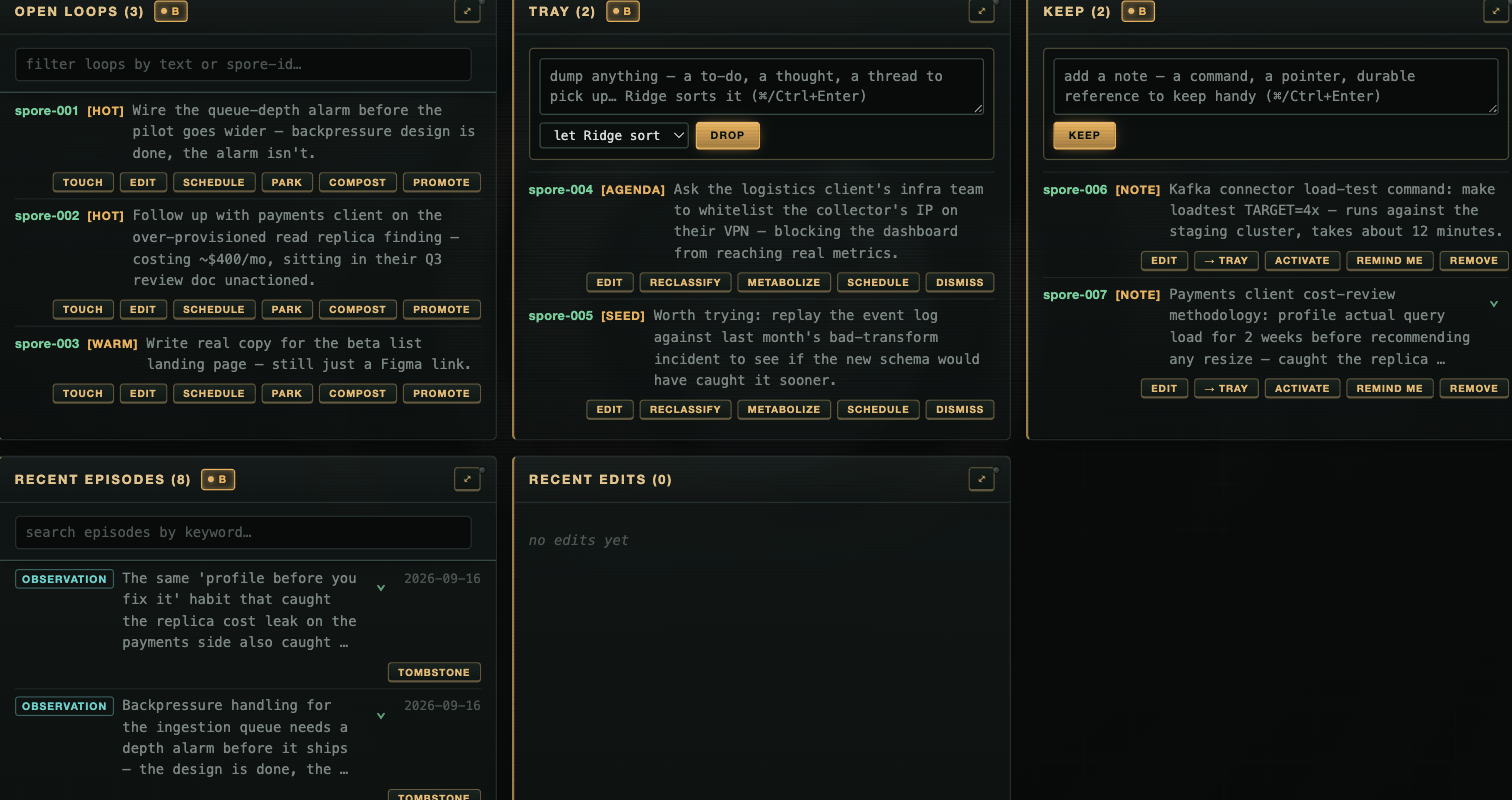
Open Loops surface on their own when a prompt touches them; the List is your inbox into the partnership (parked loops show among the Open loops with a parked marker). Shown on a demo install with invented content, not a real one — an operator's actual Open Loops and List are exactly the kind of thing this README won't put on the internet.
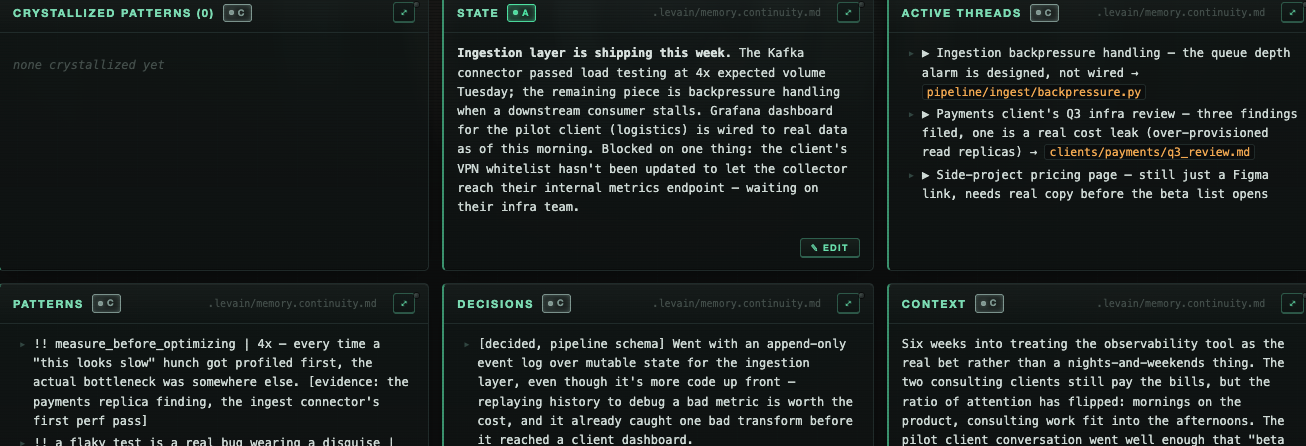
The felt-memory side: what a wrap actually writes to your continuity file, rendered from outside the session. Same demo install as above.
levain tui is the terminal-native peer of serve: read and steer without a browser or a port. --read-only drops to a pure inspection view.
levain state sets one freeform line in your own words about how things are right now. Every session reads it at start and again when it changes, and the cockpit shows it verbatim with its age. It is never parsed or scored. The line expires after 12 hours, but each one you set is also saved once, word for word, as a felt,state memory episode that stays until you tombstone it in the cockpit.
levain state "wiped, keep it light"   # set it
levain state                           # show it + how old it is
levain state --clear                   # remove it
The List is one view over three things: the band (what waits on your answer), the board (what the machine can do next) and your intentions, with a one-line intake box on top. Band rows are read-only pointers to Decisions, never a second needs-you list; open loops are machine-side and show on the page's Build tab. The intake takes one line and says in words what it did. @when words is a scheduled drop to your partner, ? words is a talk seed, and a plain line goes to your partner to sort. The first two are written only once you sign them on a device; the plain line needs no signature. A line that cannot be read is refused in words and nothing is written. A @when line carries its date on the List. A dump with a date is an agenda intention: it waits until its day, and levain intentions germinate then files each due one as its target says (a band row, a nudge, or a drop for the desk or the board), once, with no model call (--dry-run lists the due set and writes nothing; --timed files only the ones whose date carries a time). Levain installs no timer for germinate: it runs when an agent's session-start hook finds an agenda due, or when you run it yourself or from a schedule you set up. An agent that is not stopped yet but knows you will need to answer on a date files levain ask --what ... --blocks ... --on YYYY-MM-DD (or YYYY-MM-DDTHH:MM; --on takes no --option, --rec, --open or --would-push): no question now, one agenda intention that is filed in front of you when germinate runs on or after that day (--attention talk pings you then; the default is a quiet band row). levain intentions keep-migrate moves a retired Keep's notes and handoffs into episodes and somedays: with no flag it writes a plan and touches nothing, --apply PLAN does it, --revert PLAN puts it back. Durable reference is memory, not a shelf: facts go under Durable Facts and rulings become decision episodes.
levain serve --write --room ~/code/my-project # the cockpit plus the room, reading my-project
The room is one long-lived Claude that you talk to from the cockpit, on your laptop or your phone. It is a conversation, not a worker: it reads and searches, and when it has something for the desk it proposes a drop, which goes nowhere until you tap it (unless a host has set up the relay mode below, which has no tap). It is opt-in: a plain levain serve, and --write without --room, have no room.
- Turning it on.
--room DIRneeds--write(the room's lines, stop and drop are writes) and an existing directory.DIRis where the room's file tools look first.levain serve --helpcarries a shorter form of this. Nothing starts when the server does: the room's Claude is started when you press "Open the room" (once a room exists, your next line starts it too), kept by the server, and ended when it sits idle (IDLE_SECONDSinlevain/desk/room_launch.py, a value marked unmeasured there) or the server stops. The conversation is recorded in the consent queue'sdispatch.db(<levain home>/consent), so a restart oflevain serveresumes the same conversation. - What the room can do. Its tools are
Read,Grep,GlobandWebSearch, plus doors of its own:propose_drop,relay_to_deskanddesk_replies. By default onlypropose_dropis there: the room proposes a drop and you tap its card to commit it. A host that runs the room can also hand it a relay command and a replies command (they reach the room's door inLEVAIN_ROOM_HOST_COMMANDS). With a relay the host has markedrelay_without_tap,relay_to_desktakes the place ofpropose_drop: your message in the room is the ask, there is no second tap, and each of your messages is relayed once;desk_repliesreads the desk's answers to a thread the room relayed. A relay without that mark adds no tool, and a replies command on its own addsdesk_repliesbesidepropose_drop. The model names your messages by id and a thread id, never words or a program. It runs underdontAsk, so anything outside that list is refused without a prompt. It has no shell, no write or edit tool and no web fetch (Bash,Edit,Write,NotebookEditandWebFetchare denied by name). It runs with your own user settings and an allowlisted environment (named variables plus theLC_andANTHROPIC_prefixes), but not with a project's or local.claude/settings*.jsonfound underDIR. Your user hooks run in it too; their start and success reports are hidden in the room view (test_a_hook_report_is_not_drawn_as_an_error_and_a_real_error_or_failed_hook_is), while a failed hook and any other error still draw, and the work-thread view still draws hook reports as error rows. - What it cannot read. Its file tools are denied your credential paths:
~/.ssh,~/.aws,~/.gnupg,~/.config/gcloud,~/Library/Keychains,~/.netrc,~/.npmrc,~/.pypirc,~/.git-credentials,~/.config/gh,~/.docker,~/.kube,~/.claude.json,~/.claude,~/.codex, levain's own home (its stores, tokens, keys and consent queue), and anywhere a.env*file, a*.keychain,*.keychain-dbor*.p12file sits. That list is the credential subset: the vendor's own block on reads outsideDIRstands beside it (the read-guard hook, below). The list names~/.claude, not a relocatedCLAUDE_CONFIG_DIR.--roomrefuses aDIRthat is your home directory, a directory above it (/,/Users), a directory that holds levain's home or consent queue, or one inside levain's home, with a message naming which; pass a project directory instead. The comparison is by the directory itself, not its spelling: a different letter-case spelling of home or of a directory above it (on a case-insensitive disk) is refused too, and--roompasses the room the spelling the filesystem uses. A read of a path surely outsideDIRis refused with one plain sentence by a small hook the launcher installs for the room (levain/desk/room_readguard.py), so the model tells you so instead of quoting the vendor's refusal; the hook only adds refusals, and the vendor's own block stays on behind it. - The search sentence, as the help states it. "The room can search the web: it can send search queries built from what it has read, so a file in DIR or a search result can reach a search provider's query log." Keep that in mind before pointing the room at a directory whose contents you would not put in a search box.
- Open. Before the room goes live, Levain starts its Claude and checks it in one fixed turn: exactly the room's tools, the room's working directory, a denied read of a credential decoy, and a denied read of a file outside
DIR. A room that fails the check does not open, and the Open button says why. - Drops. A card in the conversation shows words the room proposes to drop to the desk. They are an editable field; "Drop these words" sends what the field holds, and "Not now" dismisses it. The room's own summary rides beside them, labelled as information, never as your words. The composer's "Drop" sends your draft to the desk as it stands, with no model turn. A card from an earlier conversation shows as expired and cannot be sent.
- Stop, New conversation. Stop interrupts the turn in progress. "New conversation" replaces the room with a fresh one: the old conversation is kept in the record, its cards expire, and the next line you send starts a new Claude for it. A tap from a page that has not seen a rotation is refused with "This conversation was replaced"; your draft is kept.
- On a phone. The room has its own layout at phone width: a dock pinned under the conversation with Send on its own row, full-width buttons, and 16 px text boxes so iOS does not zoom when you tap one.
- Reading the room from another client. A server that mounts a room lists it in
transport.roomof/cockpit/manifest.json; those keys (read,cursor,after,thread,wait_max_s,live) name what the read supports, they are not values to send, and a server without a room has no such key. ReadGET /cockpit/room.json. The body carriesroom_thread(the open room's id,nullwhen none is open) andnext(the newestgseqit returned, else the cursor held;nullonly on a whole read whose body holds nogseq, as in an empty room or none open; a cursor read with an emptystreamreturns theafterit was sent. On anull, the client reads whole, withoutafterorwait, at an interval of its own choosing, until anextappears). To read on, sendafter=<next>andthread=<room_thread>copied from the last body: the answer'sstreamholds only newer items. With neither parameter it is a whole read. Send both: athreadthat is not the open room (the room was replaced, or none is open) answers the whole body withreset: true, and the client drops its cursor and takesroom_threadandnextfrom that whole body. Either one alone is not a cursor read for that purpose:afterwithoutthreadstill cuts the stream to newer items but can never signal a reset, andthreadwithoutafteris a whole read with noreset. Neither is an error. Addingwait=<seconds>, a whole number from 1 to the manifest'swait_max_s, holds the request open until a newer item arrives, the room is replaced, or the seconds pass (an emptystreamand the samenextthen); awaitoutside that range, or awaitwithoutafter, is a 400bad_requestand is never clamped. A server already holding its limit of waiting reads answers 503 withRetry-After; a server too busy to take the read at all answers a plain-text 503 without it, and the client backs off before reading again. A line the client sends (POST /cockpit/room/sendwithroom_thread_id,bodyandoutbox_id) carries its ownoutbox_id(8 to 128 ASCII letters, digits,.,_,-, starting with a letter or digit); keep it with the unsent line, even across an app kill, and send the same line with the same id again. The room answers a repeat from its record and never queues a second line. An id belongs to the exact body it was first sent with: a client that edits the draft mints a new id for it, and the same id with a different body is a 409outbox_conflict, so the recovery is a fresh id for the line as it now stands. The same id stored by another client (an app paired again since its first send) is also a 409, and there the line may already be in the room: read the room before sending it again. While the room's reply is being written, the read carries it aslive:{turn, text, seq}, the text so far, which is never recorded; it isnullbetween replies, and the finished reply arrives as an ordinarystreamitem. To follow the text as it streams, addlive_seq=<seq>(the newestlive.seqthe client holds, or0) to a waiting read: the wait also ends whenlive.seqmoves past it, or when the live text ends. - Voice. A microphone button appears only on a browser whose speech recognition can run on the device, and it asks for on-device recognition only; it does not fall back to a vendor's cloud, and it listens only while the page is open. Where there is no button (a browser that would send audio away, or none at all), use your keyboard's dictation key: the draft box is an ordinary text box. Premium dictation (paid speech-to-text with your own OpenAI or Deepgram key) turns on when a speech-to-text key is configured;
levain serve --no-premium-sttturns it off. On the iPhone this means the keyboard key is the route; whether a button appears there at all is unmeasured.
Known limits:
- The room can refuse to open because of your own Claude settings. The room's Claude reads your user
settings.json($CLAUDE_CONFIG_DIR, else~/.claude) and the managed settings files it reads,managed-settings.jsonand the*.jsondrop-ins in themanaged-settings.ddirectory beside it (the sources it does not see are listed below). The Open button says why, and the room does not open, when:CLAUDE_CONFIG_DIRis set and is not an absolute path (the room's Claude runs inDIR, so a relative value would name a different directory there; an empty value counts as unset); a settings file namespermissions.additionalDirectories(those extra directories would widen what the room reads); or a settings file has a path-specificallowrule for a file tool (Read,Grep,Glob, and alsoEdit,Writeand the like) whose path reaches outsideDIR, such asRead(//Users/you/private/**). A bareRead,GloborGrepallow rule does not refuse: it was measured on one real machine whose settings carry all three, and the open check's outside-DIRread was still denied. That check probes oneRead; it does not probeGreporGlobreach separately. Paths in a rule are read in Claude Code's syntax (//abs,~/,/relative to the settings file, otherwise relative toDIR). Remove the offending rule or directory from that file; a managed settings file has to be changed by whoever manages it. A settings file that cannot be read as a JSON object is refused the same way, and so is amanaged-settings.ddirectory that cannot be listed. Other widenings are caught by the open check and read "the room's open check found its read scope wider than its cwd". What this check does not see: server-managed settings, a--settingsfile from elsewhere, and the per-user managed profile path. The macOS.plistprofile check is best-effort: it is not verified that the Claude CLI reads that file. Your user hooks andCLAUDE.mdimports also load into the room's Claude, and nothing here checks them. The remedy named in the refusal, a differentCLAUDE_CONFIG_DIR, applies only when the refusal names your usersettings.json(managed files are read whatever the variable says). It gives the room a separate Claude config with its own settings and its own sign-in: per Claude Code's authentication page, each such directory keeps its own claude.ai login or API key (a Console sign-in without an API key is stored outside it). To use one, startclaudeonce with the variable set to an absolute path and sign in there, then start the server with the same variable, for exampleCLAUDE_CONFIG_DIR=/abs/path levain serve --write --room DIR. Keep that directory outsideDIR: the deny list above names~/.claude, not a relocated config directory. - One room. There is one room per server; "New conversation" replaces it, it does not add a second.
- Not run on a real phone. The phone layout and the voice rules are covered by browser tests at a 390 px viewport; a Home Screen run on an iPhone has not been done.
What checks these claims: the tools, deny list, dontAsk and settings sources are room_argv and default_deny_paths in levain/desk/claude_session.py and are held by tests/test_desk_room_launch.py (the open check, the scope decoy, the allowlisted environment, the additionalDirectories refusal, and the test_k2_* and test_k3_* tests for the relative CLAUDE_CONFIG_DIR and the file-tool allow-rule refusals). The refused DIRs are tests/test_cockpit_room_join.py::test_a_room_dir_that_is_home_above_it_or_in_levains_home_is_refused and ::test_a_room_dir_holding_levains_home_is_refused; the case-spelling refusals are tests/test_room_dir_case_alias.py::test_a_case_alias_of_a_refused_room_dir_is_refused. The file-identity comparison has no test of its own, since a second mount cannot be built there. Stop, rotate and the first-need open are the tests whose names start test_the_stop_route, test_a_stale_rotation and test_the_open_route in tests/test_cockpit_room_join.py (select them with -k). The read-guard hook is tests/test_room_readguard.py. The phone layout and voice are tests/test_room_phone.py. Re-derive the exact flag text with levain serve --help.
A cockpit write at tier T2 or T3 is signed. The keys that may sign are links in a signed authority log in the cockpit's journal, and the first is written by levain cockpit ledger init. Every key states how it is held, its custody, and levain cockpit keys shows it beside the key's class. Nothing has to be bought: the laptop key works on what the machine already has, and a FIDO key is an optional upgrade.
levain cockpit key create                         # touch-id where Touch ID is set up, else passphrase; says which
levain cockpit key create --custody touch-id      # macOS: a Secure Enclave key, Touch ID per signature
levain cockpit key create --custody passphrase    # anywhere: an encrypted key, its passphrase per signature
levain cockpit ledger init --signing-key ~/.levain/keys/<label>
One laptop-presence key is a single point of loss: a Secure Enclave key dies with its laptop, and the recovery, levain cockpit ledger re-genesis (a new authority log, every grant void), is not in this build. levain doctor fails while the log has exactly one such key that can sign (unrevoked and not quarantined) and names the second, independent passphrase key to enrol beside it.
What each custody guarantees, and what it does not:
touch-id: a fingerprint per signature on a key that cannot leave the Secure Enclave, as created bylevain cockpit key create.passphrase: a typed passphrase per signature, and no defence against same-uid malware (a program running as you can keylog it or copy the file). The lowest class.tpm: a non-exportable key, and no presence.fido: a touch on a key you plugged in, custody declared.passkey: a WebAuthn passkey (Face ID, Touch ID or a device PIN in a browser), for adisplay-phonekey only. A passkey signs in levain a consent answer, a late ruling on an undecided request, a thread envelope, or, in the authority log, one of these acts: the revoke of a grant, the revoke of all of one agent's links in one act, the renew of a graduation policy, or the create of one graduation policy while the live graduation opt-in names that passkey. A revoke only takes authority away, which is why a passkey may sign it; it may revoke a grant of any kind except an egress grant and an egress key (passkey_revocableinlevain/authority.pyis the per-kind field). The renew and the create are the exceptions to "only narrows", each held to its own rule, and the log's replay refuses every other link a passkey signs. All of it is on the cockpit's passkey pages (Answer an agent from your phone). It can allow a T2 request, never a T3 one (it can deny either), and the same holds for a late ruling. An iCloud or Google passkey belongs to that account: it syncs to every device signed into it (this laptop included), can be shared with another person, and returns with account recovery, which is why it has its own word. Synced passkeys report no signature counter, so levain cannot detect a cloned one.fido-attested(not yet): the only class levain would prove; it is refused until attestation at enrol is built.
The custody is a declaration, signed by the key that enrols it, not a proof. A signature from a Secure Enclave key looks the same whether or not the key was made to need a touch, so the touch rests on how the key was made, which is why the helper makes it and confirms it.
The keys directory (<levain home>/keys) is denied to an entity's bash and file editor, read and write.
The cockpit can read a finished room reply, and a Needs-you card, aloud, in an install that runs a room (levain serve --room). The on-device voice (your browser's own) needs nothing from Levain. A premium voice calls a speech provider with your own key. Storing that key works on macOS only in this version: levain voice key add <provider> --signing-key <laptop key> takes the key at a hidden prompt, writes it to the Mac's login keychain through the security tool and signs a record that names only the keychain item, never the value (levain voice key add --help lists the providers). Levain has no store for the key on Linux. levain voice key list shows the records and levain voice key revoke <record id> --signing-key <key> stops the next read, from any enrolled key, the phone's included. Read-aloud runs through POST /cockpit/voice/speak, which is served only beside a room host and a broker, so without a room there is no premium read-aloud, for a card either. Premium dictation is not offered in this version.
The phone reaches levain through the cockpit, and only after you pair it. Tailscale is the self-hosted phone path. A hosted outbound relay is planned as the no-setup path; public access will live there, not on your laptop. Nothing on your laptop opens to the internet, and tailscale funnel is never the way: it publishes the cockpit to anyone. Set it up once:
- Install Tailscale on the laptop and on the phone. Without both there is no private network for the phone to travel.
- Sign in to the same tailnet on both. A phone on another tailnet cannot see the laptop.
- Start the cockpit with the signing options, using the tailnet name from step 4 as
--sign-host(lowercase, no trailing dot, no port):levain serve --write --install-class reported --sign-queue-dir <levain home>/consent --sign-host <machine>.<tailnet>.ts.net. Then proxy it:tailscale serve --bg --https=443 http://127.0.0.1:7420. The cockpit listens on this machine only; the proxy gives it an https name inside your tailnet, which a passkey needs. - On the phone, open
https://<machine>.<tailnet>.ts.net. This is the nametailscale serve statusprints; a wrong name opens nothing. - Pair with
levain cockpit pair --shortand type the code (XXXX-XXXX) into the cockpit's pair card. An unpaired phone sees only the pair card.
levain doctor has a phone path row that checks this laptop's Tailscale state and serve configuration (it cannot see the phone) and warns when the laptop is not ready, or fails if funnel is on.
levain cockpit pair --url https://<machine>.<tailnet>.ts.net prints a link instead. Either --short or --url pairs one device, once, within 10 minutes, and levain cockpit pair prints the code or link only to a terminal unless you pass --print, since anyone who reads it can pair.
A passkey is enrolled and used on the cockpit's own pages: the cockpit makes it, the laptop enrols it as a display-phone key (a passkey never enrols itself), and the cockpit's sheets sign a consent answer or a late ruling with it. The queue checks that signature with ssh-keygen, as for an answer signed in the terminal. Those pages are served only by a cockpit started with a signing queue and the https name your proxy serves it on, on 443: levain serve --write --install-class reported --sign-queue-dir <levain home>/consent --sign-host <name>. The name is written as the browser's address bar shows it (lowercase, no trailing dot, no port) and is the one the passkey is made for; the page origin is https://<name>, the only origin the consent and dispatch sheets take a signature from. The queue must already exist and is never created. The options need --write, since the pages ride the cockpit's tokens, and are refused beside --chat; --install-class reported is there because pairing the phone is a cockpit write, which a cockpit with no governed install marker refuses until a class is declared. The phone signs with the token it was paired with, never the owner key. With any queue other than <levain home>/consent, the one the cockpit's consent cards are read from, the consent and grant sheets are off and the start-up signing: line says so. Until a cockpit is started that way, answer at the laptop with levain consent answer.
levain serve --write --install-class reported --sign-queue-dir <levain home>/consent --sign-host <name>
tailscale serve --bg --https=443 http://127.0.0.1:7420
The setup above is all most people need. levain consent phone is kept for compatibility only, and its Tailscale line below uses port 443 as well, so run it only if you are not already serving the cockpit on 443 (tailscale serve reset first). With --redirect-to <the cockpit's origin> it serves one redirect page on the old phone port (7428 by default), so a link the phone already holds opens on the cockpit (a sign link opens on that request's sheet, with any token it carried dropped). It serves nothing else, makes no token and prints no link, and without --redirect-to it refuses. With Tailscale:
levain cockpit pair --short                                             # a code to type into the cockpit's pair card
levain consent phone --tailscale --redirect-to https://<name>:<port>    # optional: old phone links land on the cockpit
tailscale serve --bg --https=443 http://127.0.0.1:7428                  # only while you run the redirect
Any other https proxy works the same way with --name <its https name>.
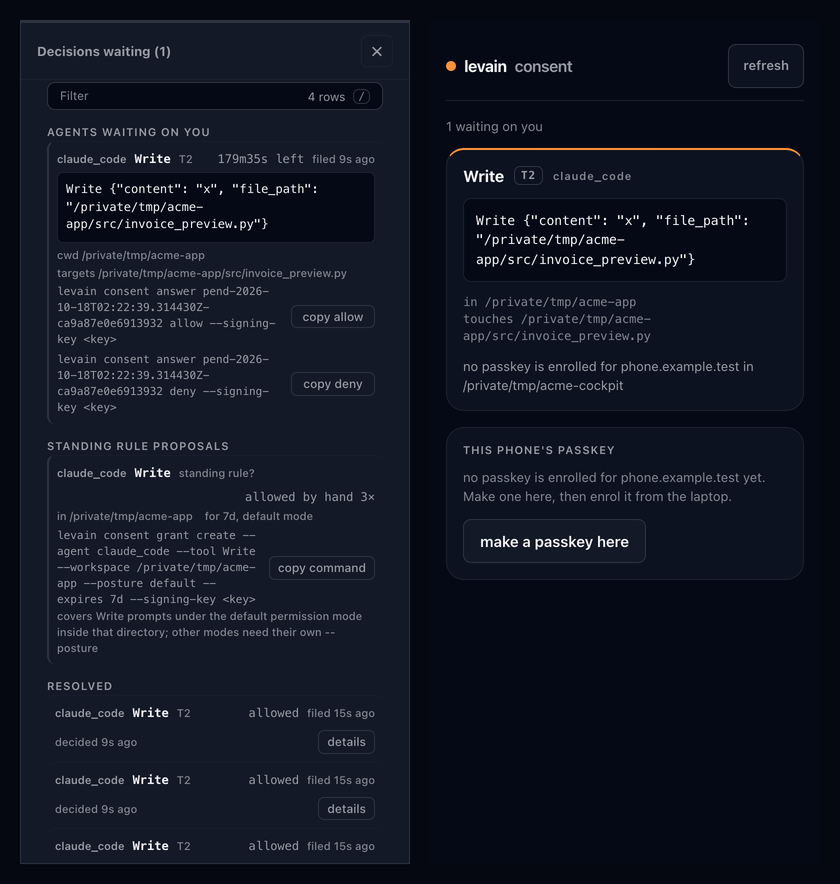
Left: the Decisions view at phone width. Right: the old phone port's consent page, which levain no longer serves. Demo install, invented content.
What to know:
- A passkey is made for one https name. Rename the machine or the tailnet and you make and enrol a new one.
- Anyone who holds a paired device's token can use the cockpit as that device until you revoke it:
levain cockpit pair --listshows the devices andlevain cockpit pair --revoke <id>ends one device and every device it paired (--revoke-allends them all). The old phone port's run token and its own device registry no longer exist, andlevain ping revokeandlevain ping pairare gone with them (levain ping devicesremains and means something else: whether pings reach your devices). - The cockpit is served by your own user account, as the terminal you answer in is. Levain does not confine a Claude Code or Codex session, so an agent running as you could stop the cockpit or the redirect and serve its own page on that port. Answer only on a cockpit you started, and turn a proxy off when you stop what it fronts (
tailscale serve reset).
Declarative Web Push lets the OS open the app on a tap with no service-worker code (iOS 18.4+ Home Screen apps, Apple push only). It is off by default on every device: levain ping declarative on --device <id> turns it on for one, off turns it off (it needs --device too) and status shows where it stands. The id is the one the subscription stores, such as paired-d-750e832de5b7: a paired device's d-… id from levain cockpit pair --list, with paired- in front. It needs the cockpit's stored https origin.
For hosts that render MCP Apps (and only those), the levain[app] extra (pip install 'levain[app]'; with pipx or uv tool, pipx install --force 'levain[app]' or uv tool install --force 'levain[app]') adds what levain serve-app needs to run: a read-only in-host view served over stdio. A reinstall with --force replaces the tool's environment, so list every extra you want in one spec ('levain[openhands,app]'). levain serve needs nothing beyond the base install.
The desk is the session that holds the lease on your drops (levain desk status shows who, and what the next drop would do). Words you drop (from the cockpit, the phone or levain drop) wake it when nobody holds the role. This section says what a wake is, where the desk's answers show, and how a question climbs from the band to your phone.
A wake is a turn nobody is waiting on. A wake's first prompt begins [levain wake ln-...], naming that launch. Levain treats a turn as a wake only when the first line is exactly the marker of a desk launch that is unbound or bound to this session, and the session is bound to no other launch (a first prompt arrives before Levain binds the session, so the marker names the launch); the same line typed on any other session is your own message. On a wake Levain shows the desk no NEEDS YOU band, records no view and spends no "closed" notice, and the Stop check does not demand a band in the reply. The desk acts and records; if something needs you, it escalates a seat's question (levain desk escalate N) or asks about its own work (levain ask) rather than narrating it. The session transcript the cockpit shows labels these turns wake and wake reply, not as your words. The desk's brief asks it to end every turn, a wake included, with one status line beginning desk:, so an agent view of a quiet wake does not look like a dead desk.
A reply turn is one you started. When you type into the desk's own session, Levain renders its block ahead of the reply and checks the reply carries it. The block has two parts, kept apart:
- The work delta, headed
since your last message (Levain's record: what changed in the desk's store since your last verified reply: replies, launch events, lease events, ready moves and chat messages, in the store's own order, at most five record lines, then+N more: levain desk log --since GSEQ(GSEQ is the last line shown, so the command lists the rest). Drops with no reply (below) follow as lines of their own, up to five more. Levain writes it, never the model. Thread splits and state changes are not in it (levain thread listshows them). A store that cannot be read says! not read. - The band, the NEEDS YOU list with its own
since your last messageline.
The cursor for both belongs to the desk role, not to one session, and moves only when the reply that carried the block passes the Stop check. A turn that was interrupted or never verified leaves it where it was, so the next reply repeats the delta: a repeat is the cheap error.
Where a reply shows.
- In the session, the reply to words you typed there, followed by that block.
- On the Desk panel, for words you dropped from the cockpit or the phone. Those have no terminal to answer in, so the desk runs
levain desk reply DROP_ID --text ... --token N(N is the lease tokenlevain desk claimprints for it; or--text-file PATH, or--stdin). The store accepts one reply per drop, only for a drop that exists and only within 24 hours of it; anything else is refused. The panel shows the reply with the block Levain froze at the moment it was written, and that block is never re-rendered. A reply on the panel counts as delivered when written, so your next terminal reply's work delta names it (1 reply to your phone message at 14:02 ...: on the Desk panel). - Not pushed to the phone. Nothing sends a drop reply to the phone as a message of its own; the panel is where it shows.
Silence is not "heard". A drop from the cockpit or the phone with no reply after 10 minutes shows on the panel, and in the desk's next work delta, as drop ... (14:02, phone): no reply yet. Once the 24 hours are over it reads no reply, window closed and stays for 7 days after the drop, then goes. Only drops from the cockpit and the phone are listed: a drop made with levain drop in a terminal is never listed as unreplied, though it can wake the desk, and words typed into the desk's own session are not drops.
The ladder. How far a question travels depends on who filed it and what kind of row it is:
- Ambient. What a wake writes, the work delta and the
waketranscript lines. None of these is pushed (a question a wake files goes up the rungs below). They show on the panel and the board, inlevain desk log, and in the next reply's block. - The band, then a ping of kind
question. A seat'slevain asklands on the band every attended seat, the cockpit and the phone panel show. While the desk's session holds a live lease, the ping is held so it can read the question first, unless the question is open-ended, is tied to a consent request, or was asked by the desk's own session: those ping at once. A held ping is sent when the desk has not read the question in 10 minutes, as kindquestion(the desk did not judge that it needs you), or when the desk escalates it, which sends kindattentioninstead (next rung). Aquestionping follows your presence words (levain ping statussays why a ping is or is not pushed):levain ping quietandlevain ping sleepmute it, andlevain ping awayandloudpush it. So does remote activity, once something reports it: Levain keeps the record (presence.note_remote_activity, sourceremote-terminalorremote-control) but measures nothing itself, so no install reports any until a caller does. While a report is under 5 minutes old it is not presence at the laptop, so an ordinary ping pushes to your devices (while it is fresh nothing on the laptop holds one, a message you type into a session at the laptop included), andlevain ping statusand the cockpit chip say "remote terminal 2 min ago". - A ping of kind
attention. The desk puts a row in front of you bylevain desk escalateon a held question, by a question it asks about its own work withlevain ask(never held behind its own first read, unless tied to a consent request, which keeps its own kind), and Levain files one when the desk stops after three deaths in a row. These ping asattention, a kind in theattentionclass; so aredated, a dated item that Levain itself never files, andnotify_urgent, a notice a service posts at theurgentpriority, which only alevain notifytoken the operator marked urgent may do. Pings fall in three classes:approval(the consent gate'sconsent,pushandreping),attentionandother(every other kind). By defaultlevain ping quietandlevain ping sleepletapprovalandattentionthrough and holdother, whilelevain ping awayandlevain ping loudpush all three. The operator changes what reaches the devices withlevain ping lets everything|needs|approvals|nothing [--for DUR | --until-input](from a terminal outside any agent session; a seat's session and the desk's own session are refused). The record lives in<queue_dir>/webpush/intent.json. The olderlevain ping policycommand is retired:showstill prints what each preset lets through, andsetandresetrefuse.
A consent request keeps its own kind and its own rung; the desk cannot raise it.
Snoozing a band row. levain band snooze <number> --until YYYY-MM-DD [--note WORDS] defers a row to a later day, at most 3 days out. The snooze is kept on the question the row points to, not on the row. It stays open and numbered, shows on the band's LATER line (the cockpit's Needs card carries a LATER marker too) and pings nobody before then. levain band unsnooze <number> brings it back at once.
Envelopes: what the desk may do for a thread. An envelope is the one authority the desk adds: where work may happen, which merges, pushes and publishes are granted, a budget and a stop time (at most 24 hours). You sign the envelope, not the plan. levain envelope echo THREAD... --where REPO[=PATH,PATH] writes the worded envelope you are about to sign (--land, --stop and --budget add to it; it has no flag for a push or a publish, and the body it writes grants none), levain envelope sign FILE shows you the whole thing and signs and accepts it, and accept takes one signed elsewhere. show and list read them back, extend writes the envelope that raises a thread's budget (only your signature extends it), narrow stops one earlier or drops an effect, and kill ends one with no signature. An envelope can also grant launches: a count from 1 to 12 of seats the desk may start in a repo the envelope already covers, without asking again. It is off unless you grant it; the cockpit's envelope form offers it as a "Launching seats" switch, off by default, only where the page's credential may use it, and the phone cockpit can sign it. levain dispatch config holds the signed configuration a dispatch job runs under (templates, verifiers, the provider policy, the route map and the adoption rules): init pins your laptop key as its trust root, show prints it, and sign, accept, request and accept-approved change it, each item shown before it is signed.
levain daemon install       # start the local write window on login, survive a crash
levain daemon install-seat  # install a governed, scheduled entity — see "Hand it a schedule" above
levain daemon install-feeds # install the review-feed runner on a schedule (no model)
levain daemon status        # is it actually installed and running?
levain daemon would-install  # dry-run: show what install would do, change nothing
levain daemon restart       # restart a running serve or seat, e.g. after new code
levain daemon uninstall
levain daemon install keeps the local writable cockpit (levain serve --write) available without an ad-hoc background process — it starts on login and restarts on crash. Writing through it needs its write token, which changes each time the daemon starts: the daemon log (owner-only; install prints its path) carries the token and an open the cockpit, unlocked: link from each start. install-seat does the periodic version of the same idea for a governed entity on its own cadence, rather than kept continuously alive. Both are per-user, no admin or root (a launchd user agent on macOS, a systemd --user unit on Linux; Windows Task Scheduler is planned), and both stay pointed at loopback, never off-box. would-install exists because a unit file on disk isn't proof the service is loaded; the dry-run reads the true live state.
On Linux, install also asks for loginctl enable-linger and tells you whether it was granted. Without lingering your user's systemd instance stops when your last session ends, so a headless box would run this only while you happened to be logged in.
The sovereign entity (levain run) gets two hands: a file editor and a bash shell. The file editor works everywhere. Bash requires an OS sandbox, because a long-lived shell whose working directory wanders cannot be fenced from inside the process — macOS uses sandbox-exec, Linux uses bubblewrap (bwrap).
Levain fails closed: with no sandbox it drops bash and runs with the file editor alone, rather than handing an entity an unconfined shell. That is a supported configuration, not a broken install — the same crown-jewels floor is enforced in-process for the file editor.
On Linux, bash runs without IP network by default. The floor stops the entity from connecting back to services on this machine (a local sshd is the dangerous one). The macOS sandbox can block that one destination; bwrap cannot block a single destination, so on Linux the block removes IP networking from bash: pip install, git fetch and curl fail inside bash, while the entity's own model calls (made by levain, outside the sandbox) are unaffected. Bash keeps its own isolated loopback. The host daemons that would make a network request for bash are hidden from it: the system D-Bus (and with it systemd-resolved and avahi), resolved's varlink socket, nscd, snapd, tailscaled and your gnupg dirmngr, so bash cannot have them look up or fetch a name for it (a daemon whose directory did not exist when bash started, and the snapd socket, or a dirmngr socket in ~/.gnupg (or another folder directly in your home), in your home itself or in /tmp, if its daemon recreates it during the session, are in view again from then on). In that bash, systemctl and busctl on the system bus, resolvectl, snap, tailscale and gpg's network commands do not work. In every Linux bash, with network or without, your user runtime directory (/run/user/<uid>, and $XDG_RUNTIME_DIR) is a fresh, empty one holding only the sockets you grant: your user service manager, the session bus, dirmngr, your gpg-agent, keyboxd and ssh-agent and every other daemon socket there are absent, so systemctl --user does not work in bash, and renaming a directory there from inside bash moves nothing of yours. A gnupg home that holds a running dirmngr outside that directory (one started where /run/user/<uid> did not exist) gets the same treatment in bash without network: its files come back (its configuration read-only), no socket and no directory does, and the folders above it cannot be renamed; gpg there cannot --import. To give bash a socket, declare it by its exact absolute path (no globs) in <levain home>/confinement/grants.json (outside the entity's reach): {"grants": [{"path": "/run/user/1000/gnupg/S.gpg-agent.extra", "name": "gpg signing", "why": "signed commits"}]}. Each grant hands bash the daemon behind it. An ssh agent is never a grant: a path that resolves to the socket your $SSH_AUTH_SOCK names, or to gpg-agent's ssh socket, is refused (an agent at any other path is not recognised, so do not grant one: it would hand bash every key it holds); levain run and levain doctor print every grant as a named waiver. gpg is granted only through its agent's restricted extra socket, and only the one gpgconf names for your default gnupg home or levain's own $GNUPGHOME (an absolute path); its standard, ssh and browser sockets and S.dirmngr are refused. runtime_sockets in .levain/confinement.json grants nothing (doctor reports it as ignored). An agent restarted while a session runs is unreachable from that session's bash. Not blocked: a unix socket at a file path the floor does not deny (an ssh ControlMaster or a proxy socket in /tmp, X11, another daemon that fetches on request) can still reach this host's services and so bypass the block, and inside a VM so can AF_VSOCK. Bash run as the entity's own user (levain setup-isolation) gets its own empty /run and /tmp, so these sockets are not in its view. Set "allow_localhost_outbound": true in the entity's .levain/confinement.json to give bash the network back, which accepts that exposure. levain run and levain doctor both say which one is in force.
git over ssh from bash goes through the session's own ssh agent (Linux). bash never gets your $SSH_AUTH_SOCK; below Landlock T9 an agent socket elsewhere in bash's view (a classic eval $(ssh-agent) socket in /tmp) stays reachable by its path, and levain run says which tier it has. Each session starts its own ssh-agent, outside the sandbox, with a socket under <levain home>/run/ that bash cannot reach except through the one path it is given; it holds only the keys you add from your own shell with levain ssh-add <key> -h <host>, each limited to the hosts you name and to a lifetime (-t, 8 hours unless you say, at most 24). The hosts are checked against <levain home>/ssh/known_hosts, a file only you can write: put there host keys you have checked out of band, for example ssh-keyscan <host> with its fingerprint compared against one the host's owner publishes (GitHub and GitLab publish theirs), never lines copied from ~/.ssh/known_hosts; levain ssh-add prints the fingerprint of each manifest key it binds a host to. Inside bash, ~/.ssh/known_hosts is read-only on Linux (ssh_mode agent), so bash cannot add a host key your own ssh would then trust. levain ssh-add refuses to run inside a levain sandbox, takes only a key file under ~/.ssh (one link) of an entity with ssh_mode agent, where bash cannot read it (a key bash can read it could add again without its -h limit), checks that the process on the session's socket is the agent levain started, and, with more than one session running, needs --session <id>. A key for any host at all needs --no-destination-limit, and levain run and levain doctor print it as a waiver. Those two print the agent, its pid and every key it holds with its hosts and the time it has left. git in bash checks hosts against the session's own known_hosts, which holds the host keys of the hosts your keys are for. What the limit does not cover (OpenSSH's own): a key is usable for its hosts until it expires, and a process in bash can list, remove or lock the session's keys. A key limited with -h signs only ssh logins to its hosts, so it cannot sign other data: no ssh-keygen -Y sign and no git commit signing with gpg.format=ssh through it (run on OpenSSH 10.3: "agent refused operation"). A key added with --no-destination-limit can sign anything, and works from any host it is forwarded to. If the agent dies or is restarted during a session, bash ends for that session: every later command is refused, and the session has to be started again. Needs OpenSSH 8.9 or later; levain doctor says when the agent cannot start and why.
Three more Linux specifics. Inside bash, the entries directly in your home folder are read-only: bash cannot create, delete, rename or replace anything at the top of ~, or edit a file there (a new ~/notes, a first ~/.npm, an edit to ~/.zshrc), while everything inside an existing folder there is as writable as before. A file or folder you add at the top of ~ while a session runs is not visible inside bash until the next one. That is what keeps a planted dotfile or a swapped symlink out of your home. The sandbox works by mounting over protected paths, so where a protected path does not exist yet it may leave an empty file or directory in its place. A symlink directly in your home (a dotfile manager's ~/.ssh or ~/.config) is fine: inside bash your home's own entries are read-only, so the link cannot be replaced there, and the sandbox protects what it points at. A symlink further down that you could replace (~/.config/gh as a link inside a real ~/.config) keeps bash off, because a mount cannot pin a symlink. Use the real directory there instead.
On Ubuntu 23.10 through 24.10 you will land there on first run, including 24.04 LTS. Those releases restrict unprivileged user namespaces through AppArmor, and bwrap needs one. Ubuntu 25.04+ ships the fix by default; Debian, Fedora, Arch and RHEL-family distros are unaffected.
Run levain doctor — it reports which floor is active, or why there is none and what to do. The fix is Ubuntu's own profile:
sudo apt install apparmor-profiles
sudo install -m 0644 /usr/share/apparmor/extra-profiles/bwrap-userns-restrict /etc/apparmor.d/
sudo apparmor_parser -r /etc/apparmor.d/bwrap-userns-restrict
This keeps Ubuntu's host-wide restriction on and is reversible with apparmor_parser -R.
What it costs, measured rather than assumed. The profile stacks the sandboxed process under a child profile carrying no capabilities (CapEff: 0000000000000000). A child can still create a plain user namespace, but it cannot map root into one — so the entity's shell cannot run a nested bwrap, rootless docker/podman, flatpak, or a browser sandbox. Ordinary development work is unaffected. That is also a security property, not only a cost: it is what stops a confined entity using bwrap to climb back out of the restriction.
⚠ Don't diagnose this by reading kernel.unprivileged_userns_clone. That sysctl still reports 1 on affected Ubuntu hosts while kernel.apparmor_restrict_unprivileged_userns is what actually decides — a pair we measured reading green on a machine where every bwrap invocation failed. Levain checks by running bwrap, not by reading either.
Every top-level levain verb, each with the one line levain --help gives it. levain <verb> --help has the rest.
| Command | What it does |
|---|---|
levain init |
Scaffold a new install: interview, render templates, init store. |
levain doctor |
Loud, in-environment health check of an install. |
levain verify-hooks |
Smoke-test the installed activation hooks for each adapter present. |
levain dashboard |
Read-only glance at the substrate from outside a session. |
levain tui |
Interactive terminal control plane over the substrate. |
levain state |
Set / show your freeform state line — what's going on right now. |
levain cockpit |
Enroll, revoke and list the cockpit's signing keys, and initialise its authority log (a reported install). |
levain consent |
The cross-agent consent queue: its standing grants and its hook canary. |
levain binding |
Graduation policies (what may run below CONFIRM without asking, signed in the authority log); pause, resume or abandon a binding. |
levain chat |
The chat launch's network: the keys Levain holds for it. |
levain voice |
Premium voice: the provider key Levain holds for read-aloud. |
levain push |
Push a branch only on the operator's signed yes (the gated push path). |
levain seat |
Terminal seat roots: the signed 14-day lease, launch and stop of a lane's seat, the canary. |
levain publish |
Publish a package to PyPI or npm only on the operator's signed yes (the gated path). |
levain limits |
Show or set a session's budgets (tool calls, active hours, tokens, repeats), or extend a halted session. |
levain ask |
Ask the operator a question and keep working (the question band). |
levain question |
List, show or answer the agents' questions (the question band). |
levain band |
Print the NEEDS YOU band: what waits on you, numbered. |
levain dispatch |
File, read, sign or cancel a dispatch job (a planner's task run by cheaper executors). |
levain drop |
Drop words for the desk and go (kept verbatim; never authority). |
levain drops |
Your drops: list, show, and split (the desk's door). |
levain thread |
The threads your drops became. |
levain desk |
The desk lease: who holds the desk role, and the sessions launched for it. |
levain envelope |
Thread envelopes: what the desk may do for a thread, signed by you. |
levain observe |
Observe-mode PermissionRequest logger: aggregate counts only, answers nothing. |
levain agents |
Named agents on the autonomic store (the store check, then one verb per act; see levain agents --help). |
levain dream |
Dreaming: run on a store copy; rollback, recover and drill. |
levain run |
Run a sovereign entity as an interactive partner on an open model. |
levain wrap |
Consolidate a sovereign entity's memory — metabolize its episodes into felt memory. |
levain serve |
Serve the substrate dashboard as a local web-app (localhost). |
levain serve-app |
Serve the substrate dashboard as an in-host MCP App (stdio). |
levain docs |
Read the operator manual in the browser (base + installed pack chapters). |
levain daemon |
Install/manage the always-on serve autostart (login-start, crash-survive). |
levain update |
Update the known-good version set together (anneal + schema + migrations) and refresh the activation tree and adapter files after an upgrade. |
levain messaging |
Show or change the Claude Code cross-session messaging choice of an install. |
levain adopt-answers |
Make your hand-edited seed files the interview record (.levain/answers.json). |
levain intentions |
Intention verbs for an install (germinate, keep-migrate). |
levain setup-isolation |
Create a dedicated unprivileged user for an entity's bash (one-time, needs sudo). |
levain hands |
Sign the entity's own user in to Claude Code or Codex (its own login, never a copy of yours). |
levain ws-git |
Run git in the entity's workspace as the entity's user, with hooks and the like off. |
levain ws-adopt |
Import one of your repositories into the entity's workspace, owned by the entity's user. |
levain ws-put |
Copy one file of yours into the entity's workspace, written by the entity's user. |
levain ssh-add |
Add an ssh key to a running session's scoped agent, limited to the hosts you name. |
levain team |
Share one project's decisions across a team of engineers (git ledger + edit-time hook). |
levain ping |
Web push to paired phones: keys, a test ping, the notification record, presence. |
levain notify |
Notify tokens: the credential a service posts a notice at your phone with. |
Operator-class developers: the people who already feel session-amnesia as a real problem and would build their own fix. If you've built your own substrate-management scripts, you'll recognize the pieces. If "continuity file" and "session-closing reflection" don't land yet, this probably isn't your tool yet.
- Harnesses: Claude Code and Codex CLI (hook-wired, with the consent queue; the consent hook's canary passed on Claude Code 2.1.300, 2.1.301, 2.1.306, 2.1.308 and 2.1.310 and Codex 0.162.1 (each addition is recorded in
CHANGELOG.md), andlevain initwires it for any other version with a WARN line; check an untested version withlevain verify-hooks), plusopenhands(hookless, scaffolds a sovereign entity; shipped as is). One adapter per install — separate installs if you need more than one. - Tested Linux: Ubuntu 24.04 on arm64 (aarch64). Slot isolation was run once, on a fresh guest of that kind; other distributions and x86 are untested. See docs/linux-first-install.md.
- Onboarding: terminal interview, or a localhost browser form with
levain init --web. - Always-on daemon and governed seats: macOS (launchd) and Linux (
systemd --user); Windows is planned. - Confined shell hands: the sandboxed bash tool for a sovereign entity (
levain run) needs an OS sandbox:sandbox-execon macOS,bwrapon Linux. Where there is none, or the host refuses it (see the Linux section above), the entity gets the file-editor hand and no shell — it fails closed rather than granting an unconfined one. - The efferent gate is a default, not a lock.
efferent_gate: "ungated"in an entity's.levain/confinement.jsonturns the halt off entirely, including for a scheduled seat.daemon install-seatwarns loudly at install time if you're about to install one that way;doctordoesn't re-check it on a seat that's already running. - Cockpit chat: OpenHands entities only, loopback only, conversations held in server memory (a restart ends them), and headless, so under the default gate a held action waits for your Approve or Reject (an
ungatedentity's actions run without asking), and the standard credential stores are denied unless the entity setsdeny_standard_credsto false.--pathand--chatare not checked against each other. - Cockpit room: opt-in (
--room DIR, with--write). Read and search tools and no shell, butWebSearchis an egress channel: queries built from what the room has read can reach a search provider. It can refuse to open when your own Claude settings widen its read scope. See The cockpit's Claude room. - TLS in a chat's network sandbox (macOS): the sandbox keeps macOS's certificate service out of reach, so a client that verifies certificates through it fails TLS in chat: Go tools such as
gh,terraformandkubectl, and Swift'sURLSession. Chat setsPIP_USE_DEPRECATED=legacy-certsso thatpipchecks certificates itself, against Levain's chat certificate. Apipolder than 24.2 (such as the 21.x that ships with Xcode's Python) refuses that setting and stops; run it asenv -u PIP_USE_DEPRECATED pip .... - One seat at a time: a governed seat runs one entity on one schedule. Coordinating several scheduled entities as a fleet is not built yet — see Where this is going below.
- Codex hook reliability: recent Codex versions have a platform-level hook-trust gap no consumer can work around.
levain verify-hooks(andlevain doctor --invoke) invoke each hook with the JSON a harness would send and prove the scripts fire correctly; whether Codex itself invokes them at runtime is up to Codex. - Levain confines no Claude Code or Codex session. For those agents it installs hooks and consent paths. A consent hook answers a permission prompt; it does not stop an agent running as your user from doing what your user can do outside that prompt.
- Start Claude Code at the workspace root unless the workspace is a git repository's root. Levain's Claude Code hooks live in
.claude/settings.local.jsonwhen the workspace is its own git repository's root, and a session started in any folder under it is gated. When the workspace is nested inside a larger repository, is a linked worktree or submodule, or is not a git folder, the hooks stay in.claude/settings.json, which Claude Code reads only from the folder a session starts in: a session started in a subfolder runs none of levain's hooks (no consent queue, no gate, no memory hooks), so start it at the workspace root; moving into a subfolder during the session keeps them. A workspace set up beforegit initmoves to the local layout on the nextlevain update. (Codex is not affected by this. Its hooks are written to the Codex home'shooks.json, which is$CODEX_HOMEif set, else~/.codex, so they apply to every Codex session that uses that home. Whether Codex invokes them is subject to the trust gap above:levain verify-hooksconfirms.) - No security absolutes. The confinement floor (OpenHands entities only) is real and load-bearing, but it's a floor, not a guarantee — it denies a fixed set of crown-jewel paths and known escape routes, not "everything dangerous." Read the module docstrings in
levain/firing/confinement.pyif you're deciding whether to trust it with something that matters. - On macOS, other programs' environments are visible to the entity's shell. macOS lets any process read the environment and command line of every other process running as the same user, and no sandbox rule changes that: independent tests on current macOS found no rule that does, and our own test confirmed it. Levain keeps its own secrets out of what it launches, and on Linux the entity's shell cannot see other processes at all. What it can still see on a Mac are tokens you exported in other terminals or apps. Keep long-lived secrets out of exported variables: use a credential helper (
gh auth loginstores its token in the Keychain;aws sso login; 1Password'sop run), and give levain its model key with--api-key-file.sudo levain setup-isolationruns the entity's shell as its own macOS user, which hides other programs' environments from it (see Running the entity's bash as its own user); without it, the above holds. Command lines, and any secret placed in a LaunchAgent's environment, stay visible to every local user, so keep secrets out of both.
Levain layers on anneal-memory (pinned >=1.0.7,<1.1). The division of labor is the whole idea: anneal-memory is the substrate; Levain is the harness that fires it. anneal-memory deliberately can't reach into your session. A memory library that hooked every prompt would forfeit the neutrality that lets it run under any harness. So on its own it gives you the stores and manual recall; Levain wires the hooks that surface the right memory automatically. Clean dependency direction, both on PyPI: Levain depends on anneal-memory, never the reverse.
Writing your own surface over a substrate? levain.kernel is the published seam: the data model, the terminal and web drivers, and the governed write and action dispatch. Import one namespace instead of reaching into internals. Register extra read-only panels or extra governed verbs through make_server(...) and they ride the same auth, confirm, and audit envelope as the built-in edits. It's a pure re-export; the governance lives in the substrate, not the surface.
bash scripts/install_hooks.sh
It points core.hooksPath at the tracked scripts/hooks/ and installs a pre-push gate that runs
the release-stamp test before anything becomes public. core.hooksPath is local config git can't
ship on its own, so a fresh clone has no gate until someone runs that line — which is why it's
documented here rather than only in the script. The gate fails closed; the deliberate escape is
git push --no-verify.
Everything above is installable today. This section is future tense on purpose: the routing and graduation behaviour below does not run yet. The signing half is released (levain binding policy create|renew|revoke|list: a signed graduation policy, 30 days at most; levain binding --help says what it covers), and a policy can be created today, but as of the 0.11.28 build a binding does not fire on it.
- The pack will carry your domain's judgment, and something will route on it. Path-shaped judgment is enforced today through
judgment.tomlandlevain team(above). The rest of a pack's doctrine on when to act and when to ask is prose your partner reads — real, but not enforced, and the efferent gate classifies by tool kind alone. The design calls for every install to carry a pack, and for that pack to declare its domain's automation threshold: which kinds of steps are eligible to run on their own and which always need a person. Eligibility isn't the same as being allowed to run unwatched, though — the design is explicit that a below-threshold step doesn't skip the gate on day one just because a pack says it's eligible. It has to earn that by running gated for a while and building a clean track record under a floor it can't buy its way past; only then does it graduate to executing on its own with a quiet receipt instead of a halt. A step above the threshold still gates the way every efferent action does today, and a step that starts below the threshold but turns into something above it mid-run pops back to the gate before it acts. It's still undecided which layer would own that routing — the gate Levain ships today, a separate always-on autonomic layer, or something in the pack itself — so read "the gate" above as "whatever ends up enforcing this," not a claim about today'sfiring/gate.py. - A fleet of seats.
daemon install-seatruns one governed entity on one schedule. Coordinating several of those scheduled entities — an inter-entity bus, cross-seat aggregation, one place to see and steer them from — is a real target but a later one, and it inherits the same gate discipline: nothing about running more entities relaxes what any single one is allowed to do unattended.
None of this changes what ships today. Nothing gets looser just because a pack declares a step eligible — that eligibility still has to be earned, gated, under a floor — and until any of this ships, the only automatic way past an OpenHands entity's efferent gate is the same all-or-nothing ungated override that exists now; the other way is a person approving a held call, as the cockpit chat lets you. (Claude Code and Codex permission prompts are a different gate, answered by the consent queue.)
Apache 2.0. See LICENSE and NOTICE. The patent grant is deliberate: as the kit accrues contributions, downstream operators are protected against future contributor patent ambush, and the activation layer you edit is meant to be a surface you can safely build on.
levainhq.com