
Point it at a real GitHub TUI repo. It studies the code, figures out the framework, and generates a small original TUI in that same framework — then proves the result actually runs.



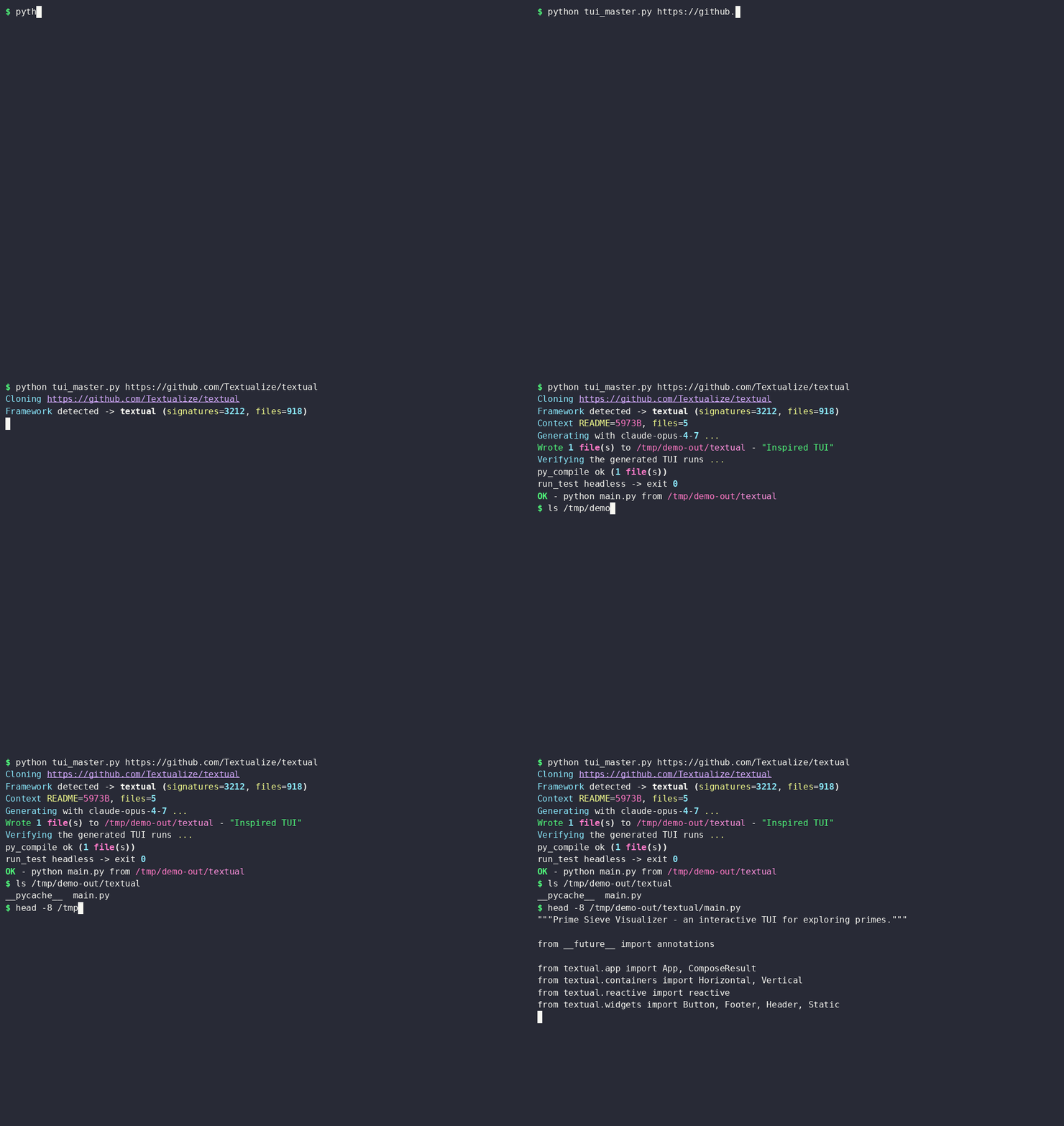
One real, uncut run (long waits trimmed): clone → detect → generate → headless-verify → the generated app's code.
python tui_master.py https://github.com/Textualize/textual
# Cloning https://github.com/Textualize/textual
# Framework detected -> textual (signatures=3212, files=918)
# Generating with claude-opus-4-7 ...
# Wrote 1 file(s) to output/textual - "Pixel Pond"
# Verifying the generated TUI runs ...
# run_test headless -> exit 0
# OK - python main.py from output/textualThis project was scoped on January 23, 2026 as an ambitious multi-agent
system — three sub-agents, a compounding learning database, six frameworks, a
Termux converter. The full spec is preserved, untouched, in
ARCHITECTURE.md, frozen at the
v0.0.1-before
tag.
Then it hit a wall. The hard part was designing "patterns as a data structure," the scope was wide, and it sat dormant for four and a half months — an architecture spec and zero implementation.
The GitHub Finish-Up-A-Thon was the forcing function. In the final sprint I deliberately cut the scope to the spine and shipped the one thing that makes the whole idea real: a working single-agent generator. The sub-agents, learning DB, and Termux converter are honest roadmap items (see below), not claims.
This isn't the finished vision. It's the start of finishing.
| Exhibit | Link |
|---|---|
| The "before": the frozen spec, zero implementation | repo at v0.0.1-before |
| The whole comeback in one diff | v0.0.1-before...main |
| The original Jan 23 spec, untouched since | ARCHITECTURE.md |
(One honest note on dates: the spec is dated January 23; the public repo was
created May 26 to freeze that spec verbatim as the v0.0.1-before exhibit
before the build began. The dormant months lived in a drawer, not in git.)
A single-file orchestrator, tui_master.py, runs the whole
pipeline inline:
- Clone the given GitHub repo (shallow).
- Detect the TUI framework with heuristics, not AI — file-extension counts plus import-signature grep. A Rich-only repo is never mistaken for Textual; a Go repo is recognized as Bubble Tea.
- Gather the README plus the few most framework-dense source files.
- Generate a small, original TUI in the same framework in a single
claude-opus-4-7call. - Write it to
output/<framework>/. - Verify it runs — framework-native and headless, no TTY required:
Textual via its official
run_test()pilot, Bubble Tea viago build.
| Framework | Language | Detection | Generation | Headless run-verification |
|---|---|---|---|---|
| Textual | Python | ✅ | ✅ | ✅ run_test() |
| Bubble Tea | Go | ✅ | ✅ | ✅ go build |
| Rich | Python | ✅ | ✅ | ✅ headless render run |
| Ratatui | Rust | ✅ | ✅ | not yet |
| Ink | JS/TS | ✅ | ✅ | not yet |
| Cursive | Rust | ✅ | ✅ | not yet |
Three frameworks across two languages are wired end-to-end with automated run-verification. The detector covers all six.
uv venv && uv pip install -e ".[dev]"        # or: pip install -e ".[dev]"

# Anthropic SDK creds (ANTHROPIC_API_KEY; ANTHROPIC_BASE_URL if self-routed)
export ANTHROPIC_API_KEY=sk-...

python tui_master.py https://github.com/Textualize/textual
python tui_master.py https://github.com/charmbracelet/bubbletea
Useful flags: --framework {textual,rich,bubbletea,...} to force one,
--out DIR, --max-files N, --dry-run (clone + detect only, no API call),
--no-verify, --local PATH (skip cloning).
See examples/ for sample generated TUIs (a Textual "Pixel Pond"
and a Bubble Tea Pomodoro timer) — committed verbatim as the model produced them.
The original ARCHITECTURE.md vision, tracked as issues and
explicitly not built yet:
- Pattern Learner sub-agent — extract reusable UX primitives across studied repos
- TUI Validator sub-agent — score output against an "awesome-tuis" quality bar
- Termux Converter sub-agent — Android-friendly variant of each generated TUI
learning_db.json— compounding symbolic memory across study sessions- Headless run-verification for Rust / JS frameworks (Ratatui, Ink, Cursive)
Architecture, orchestration, and the verification harness: Claude Code
(claude-opus-4-7). Generation calls go through the Anthropic Python SDK.
Conventional Commits; MIT licensed.
Frameworks studied and credited: Textualize/textual, charmbracelet/bubbletea, Textualize/rich, ratatui/ratatui, vadimdemedes/ink, gyscos/cursive.
MIT. See LICENSE.